Podcast › Episode 7

How to Tell What Kind of Family Court Date Is on Your Notice

Episode 7: What Kind of Court Date Is This?

By David Martino16:14November 19, 2026

Legal information, not legal advice. Listening doesn't create an attorney-client relationship, and reading this page doesn't create one either. Court rules vary by state and court.

The question

My notice gives me a court date. How do I figure out the kind of event on my calendar?

Audio only
Also in your podcast appApple PodcastsSpotifyYouTubeRSS feed

You know when you have court. You may still have questions about what will happen that day.

The notice says “Pretrial Conference.” You put the date on your calendar and begin gathering messages and photographs. Then you look at the notice again. Is this the day for witnesses? Is the judge deciding something? Is there another document to read before the conference?

Those are useful questions. Knowing the date is only part of understanding the event. Episode 7 of The Steadycase Podcast covers the different kinds of family-court dates and how to use your notice to understand the event on your calendar. The examples come from official court sources in California and Massachusetts. Your own court’s notice, orders, and instructions supply the details for your event.

Status and case-management conferences

The general purpose of a status conference or case-management conference is to review the progress of the case and determine the next procedural steps. The discussion may concern what remains unfinished and how the case will move toward resolution.

California has a particular event called a family-centered case-resolution conference. The court’s rule says this conference is intended to develop a plan for resolving the case. It is not intended as an evidentiary hearing.

That distinction shows why the full event name is useful. Even so, a conference deserves preparation. The same California rule expects the participants to be familiar with the case and prepared to discuss their positions on the issues.
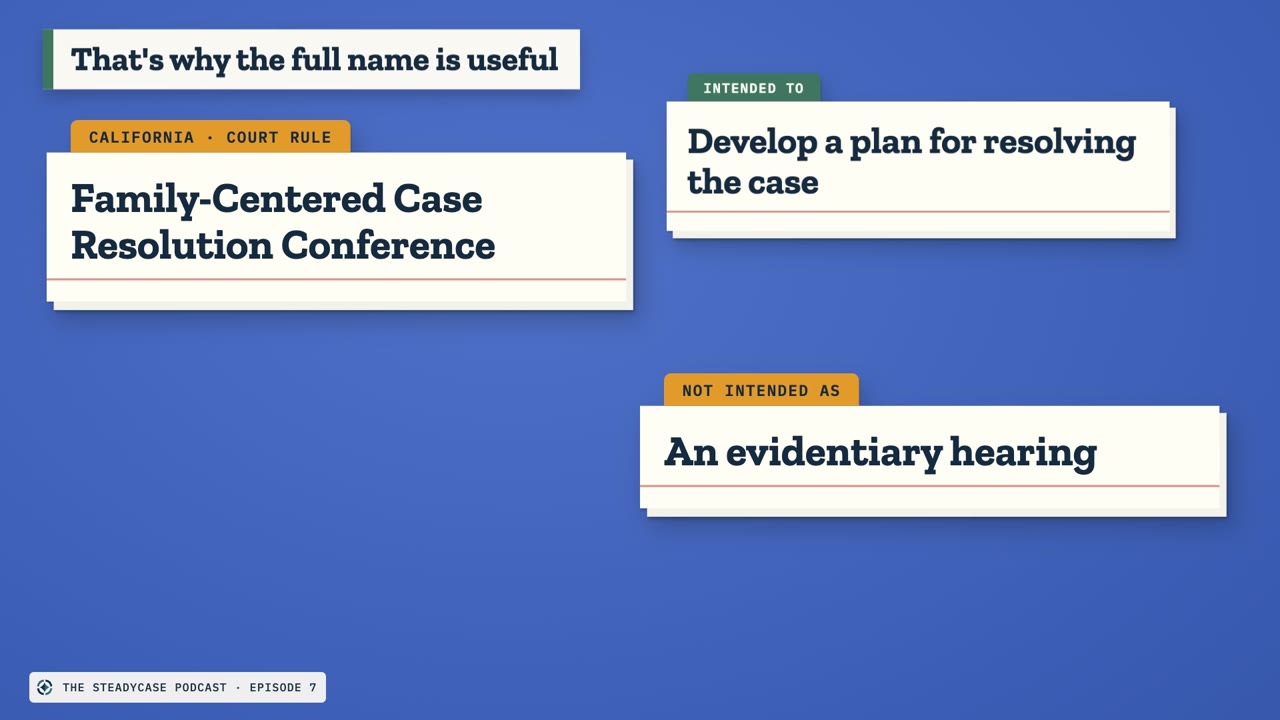
Slide titled That's why the full name is useful. A card labeled California, court rule, names the Family-Centered Case Resolution Conference. Beside it, intended to: develop a plan for resolving the case. Not intended as: an evidentiary hearing.
One California event and its stated purpose.

Pretrial conferences

As the name suggests, a pretrial conference is preparation before a trial. In Massachusetts, the domestic-relations rule on pretrial procedure lists several possible subjects, including narrowing the issues and exploring settlement. The rule also addresses agreements about facts and documents that could reduce the amount of proof needed at trial.

There can be consequences for the later proceedings. That Massachusetts rule provides for an order recording the action taken at the conference and limiting the issues for trial. So “pretrial” does not mean “nothing important happens.”
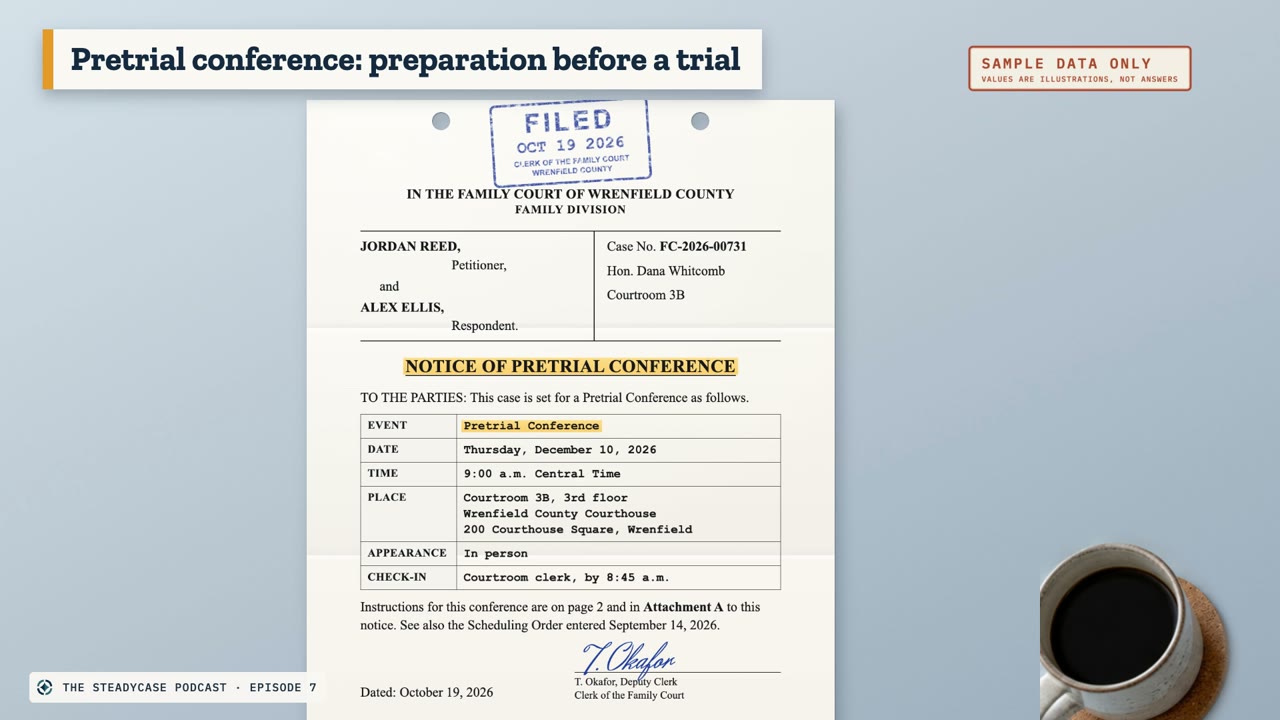
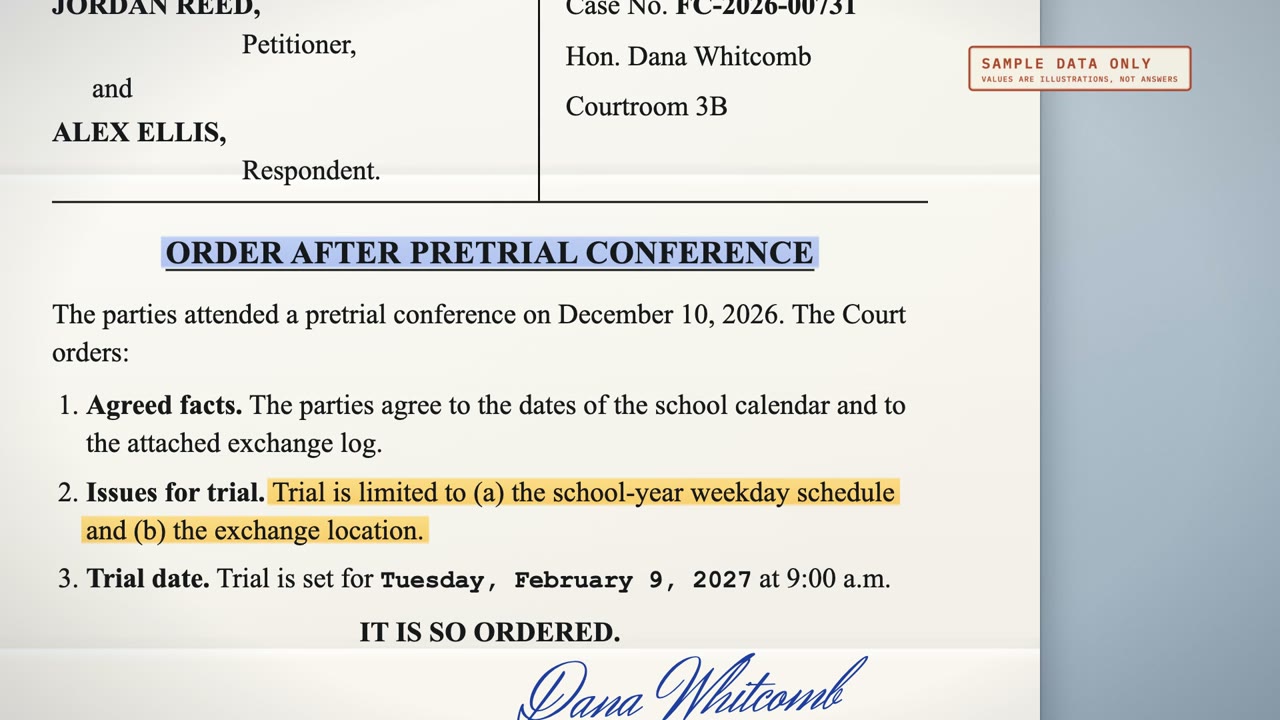
A fictional Notice of Pretrial Conference from the Family Court of Wrenfield County, on a green ground under the heading Pretrial conference: preparation before a trial. Marked Sample data only.
Sample data only. A fictional notice.
A fictional Order After Pretrial Conference with a highlighted line limiting the trial to two issues, signed by a fictional judge. Marked Sample data only.
Sample data only. A fictional order that limits the issues for trial.

Settlement conferences

A settlement conference has a related but more specific focus. Its purpose is to explore whether the parties can resolve some or all of their disagreements through an agreement. Massachusetts’s family-court standing order describes that purpose and treats settlement conferences, pretrial conferences, and trials as distinct events.

These descriptions can overlap. A pretrial conference may include a settlement discussion. The particular court’s instructions explain the planned event more clearly than a general definition.

Hearings on requests for temporary orders

California’s divorce self-help guide describes a temporary order as a short-term decision while the case is still active. The subjects can include a custody schedule or support. The word “temporary” describes the decision’s place in the ongoing case. It doesn’t make the subject unimportant to the people involved.
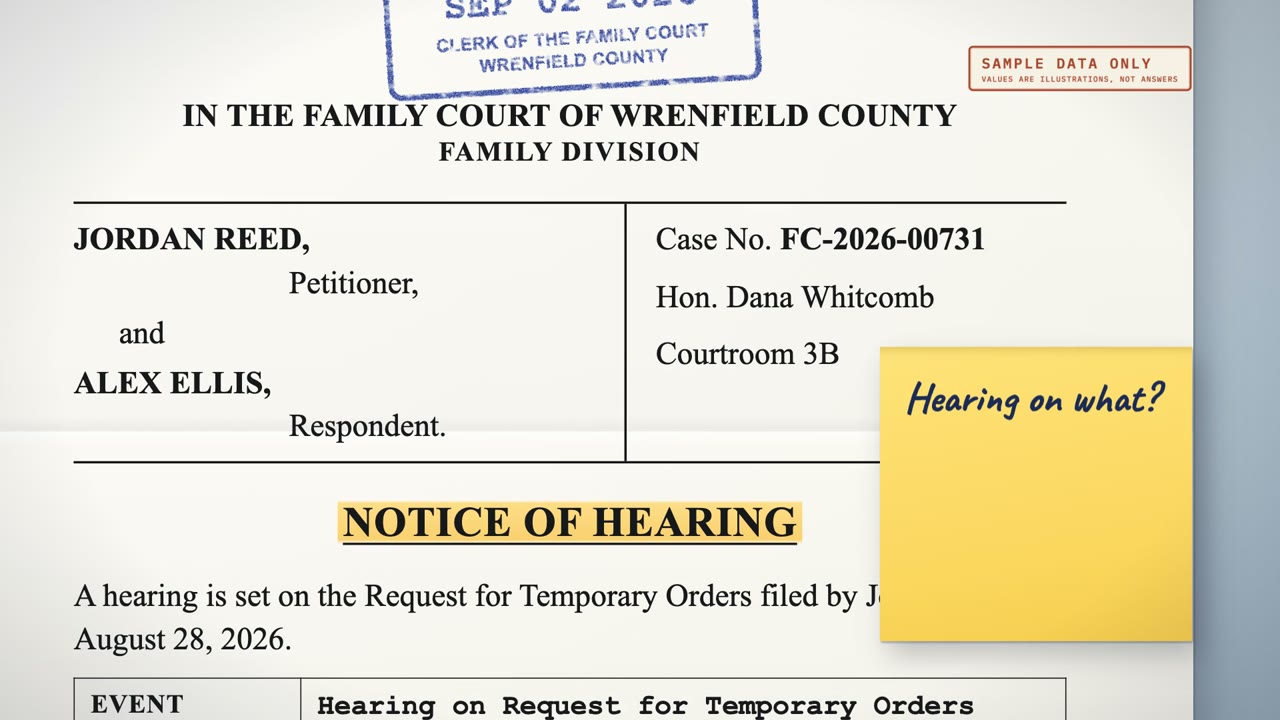
A fictional Notice of Hearing with a sticky note reading Hearing on what? The event line reads Hearing on Request for Temporary Orders. Marked Sample data only.
Sample data only. The word “hearing” needs the rest of the line.

Trials and evidentiary hearings

Evidence is central to a trial, or to an evidentiary hearing on particular disputed questions. California’s divorce-trial guide describes each side presenting a case through testimony, witnesses, and other evidence. Testimony means speaking under oath. A document or other item offered as evidence is called an exhibit. Rules govern what the judge can consider.

An evidentiary hearing may focus on a narrower question than the entire case. To understand the scope of a particular event, give the notice and related orders a close read.

None of this is a fixed sequence that every family follows. It is a way to recognize the different purposes behind the names. A date on the calendar could involve planning the next steps, discussing an agreement, or presenting evidence for a decision.
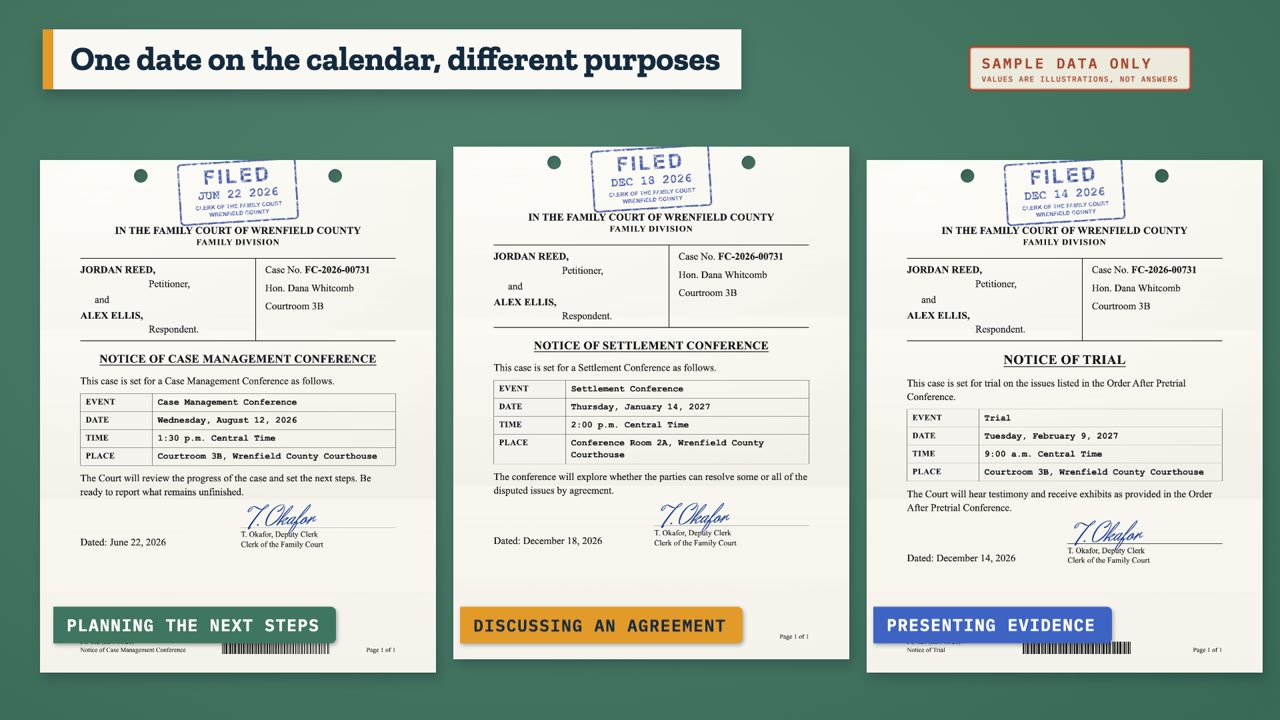
Three fictional notices side by side under the heading One date on the calendar, different purposes. Their labels read Planning the next steps, Discussing an agreement, and Presenting evidence. Marked Sample data only.
Sample data only. Three notices, three purposes.

Read the complete notice

A useful starting point is the court’s name and the case number. Those details identify the case and the source of your instructions. Then copy the exact event name into your notes. A calendar entry that says only “court” is harder to understand a month later.

Next come the appearance details. These include the date and time, and the place or method of appearance. An in-person notice may identify a courthouse and courtroom. A remote notice may refer to connection instructions somewhere else. If a time zone is stated, include it. Check-in directions deserve their own line.

Then read the rest of the notice. A second page may contain preparation instructions. The first page may refer to an attachment or an earlier scheduling order. A reference to another document is a reason to locate that document, rather than guess about its contents.

It helps to separate the appearance information from the preparation information. One tells you when and how the event takes place. The other describes what the court has directed before or during that event.
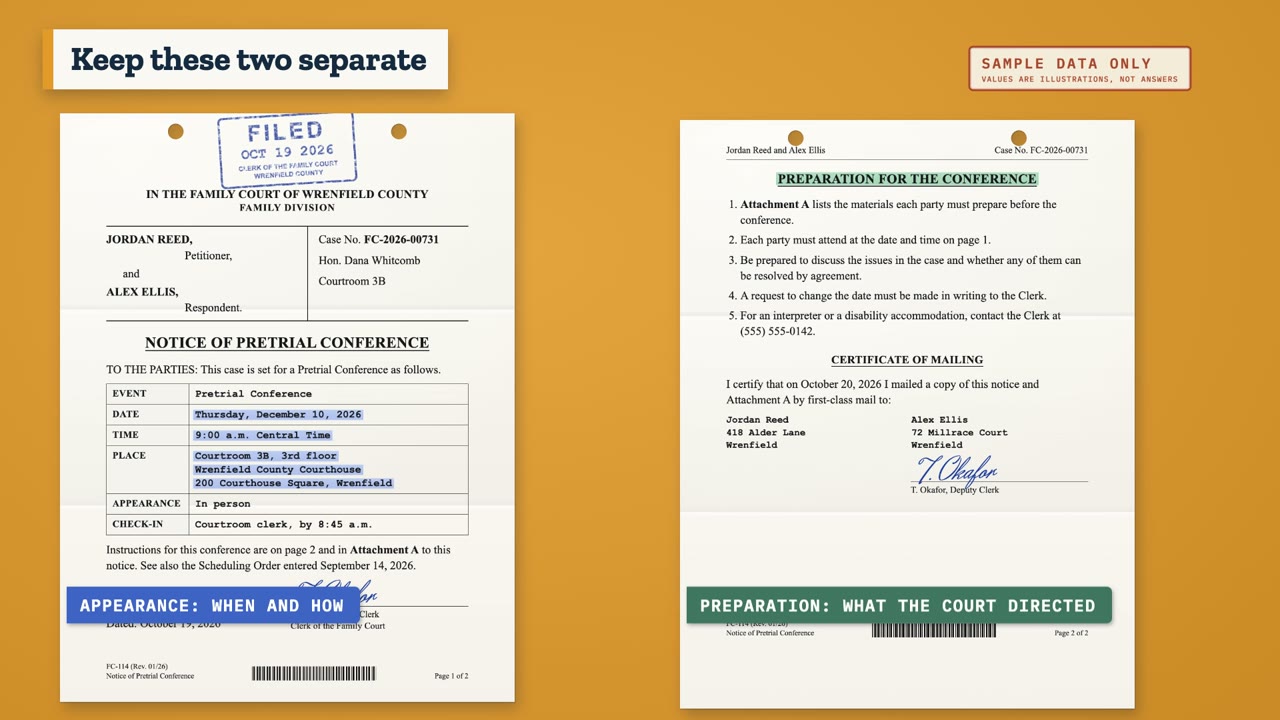
Two pages of a fictional notice under the heading Keep these two separate. The first is tagged Appearance: when and how. The second is tagged Preparation: what the court directed. Marked Sample data only.
Sample data only. Appearance details and preparation instructions, kept apart.

Keep each date with its label

A filing stamp, the date you received a document, and the date of the appearance describe different facts. Keeping the label beside each date preserves the distinction.

Your notes can also identify the source of each entry. “Appearance time, first page of notice” is more useful than a time copied without context. If you confirm something through an official court resource, record that source and the date of the check.

There will sometimes be a blank in those notes. Perhaps the notice refers to an attachment missing from your papers. Perhaps the remote-appearance instructions are unclear. A useful entry identifies the question and the official source for clarification. A plain sheet of paper can hold all of it.
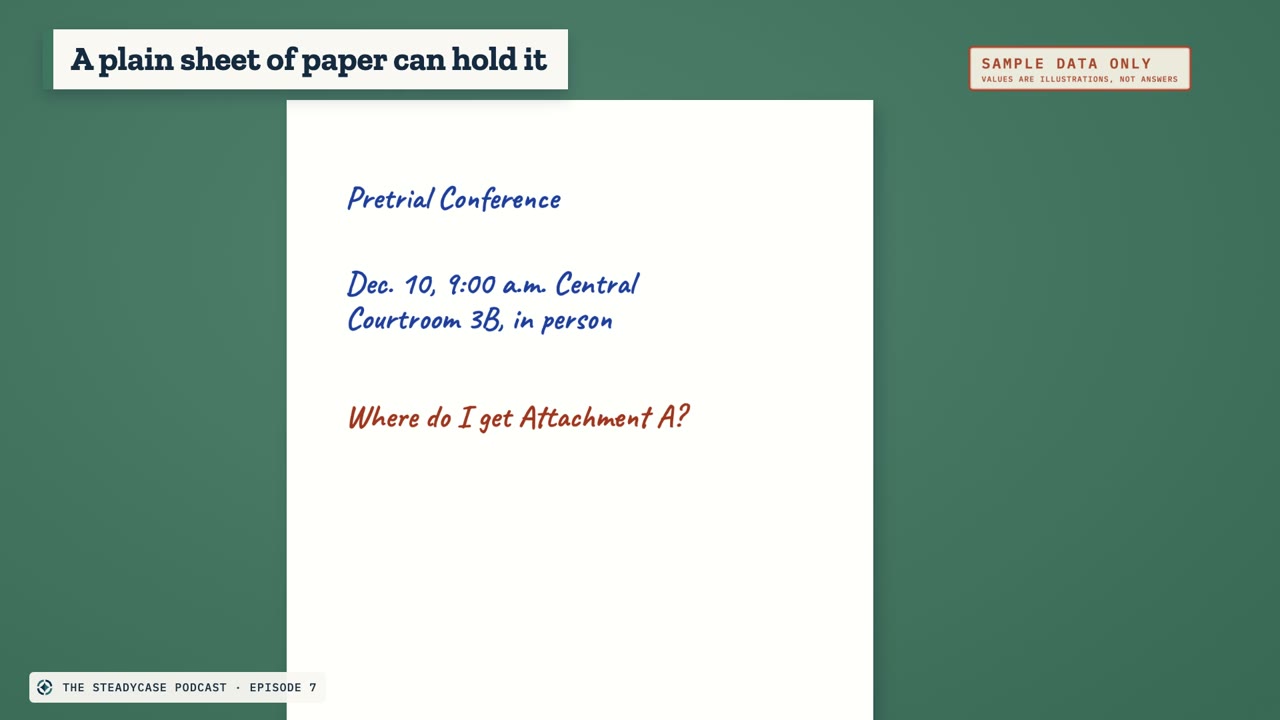
A plain white sheet with handwritten notes under the heading A plain sheet of paper can hold it. Pretrial Conference, December 10, 9:00 a.m. Central, Courtroom 3B, in person, and the question Where do I get Attachment A? Marked Sample data only.
Sample data only. The event, the details, and the open question.

“My notice says pretrial conference. Is that my trial?”

These three questions are examples we put together for the episode. A pretrial conference and a trial have different purposes. The conference can address preparation, disputed issues, and possible agreement. At a trial, the court receives evidence to decide disputed questions.

For your own notice, the useful next step is to find your court’s description of that exact event. The notice may identify papers for the conference or refer to a separate order. Those instructions deserve attention even if the event isn’t called a trial. Whether witnesses will testify, what documents are required, and which issues are scheduled need confirmation in the court’s own materials.

A search for “pretrial conference” can return information about criminal cases, civil lawsuits, and family cases. Adding the court’s name and “family court” helps narrow the search. The result still needs a check against the court and case type on your notice.
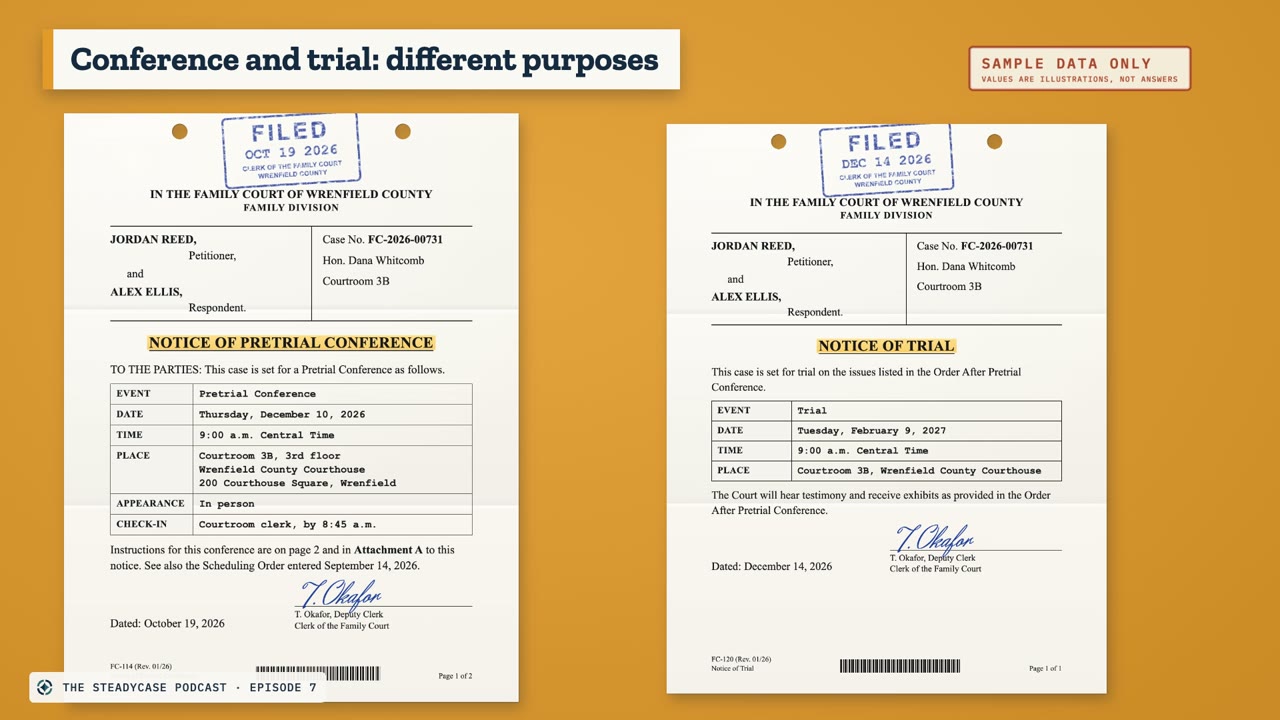
A fictional Notice of Pretrial Conference beside a fictional Notice of Trial, under the heading Conference and trial: different purposes. Marked Sample data only.
Sample data only. Two events, two notices.

“The papers have several dates. Which one goes on my calendar?”

There may be more than one useful calendar entry. The appearance date gets its exact event name. If the papers expressly give a separate date for a preparation requirement, that date gets its own entry, with the court’s wording and the source.

The filing date and the date you received the papers remain in your records with their own labels. Recording those facts does not determine which date starts a legal deadline. Copying a date is an organizational step. Determining the deadline that applies to a particular filing may require checking rules, service requirements, and court orders.

So your notes might say “date on filing stamp” on one line and “date received by mail” on another. Neither line should silently become “response due.” That would add a legal conclusion that wasn’t in the original entry.

If two documents seem to list different appearance details, keep both documents and identify the discrepancy for confirmation. Court staff or a self-help center may be able to point you to the applicable procedural information. When the answer requires legal advice about your own circumstances, an attorney licensed in your state can help you evaluate that question.
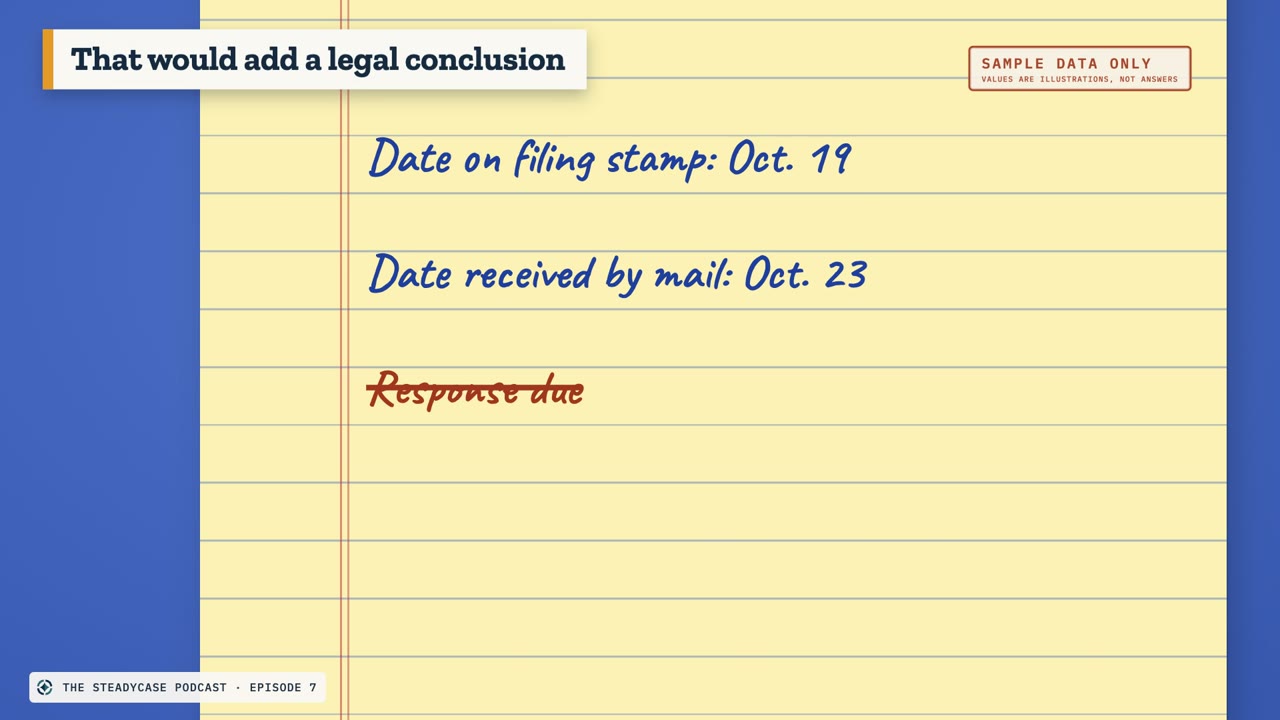
A yellow legal pad with two handwritten lines, Date on filing stamp: Oct. 19 and Date received by mail: Oct. 23, and the words Response due struck through, under the heading That would add a legal conclusion. Marked Sample data only.
Sample data only. Two labeled dates, and no added conclusion.

“The notice doesn’t say what happens that day. Where can I find an explanation?”

Begin with the court named on the notice. Its official website may have a family-law section, information for people without attorneys, or instructions for the named event.

A page from another court can explain a general term. It doesn’t establish the instructions for your appearance. A clear explanation from another state may sound like the exact answer. Before relying on its procedure, check the court’s name and its type of cases.

If the official materials don’t resolve the question, a clerk’s office or court self-help center can be a source of procedural information, within that office’s services. A specific question is useful. “Where are the published instructions for this type of conference?” points to the exact information.

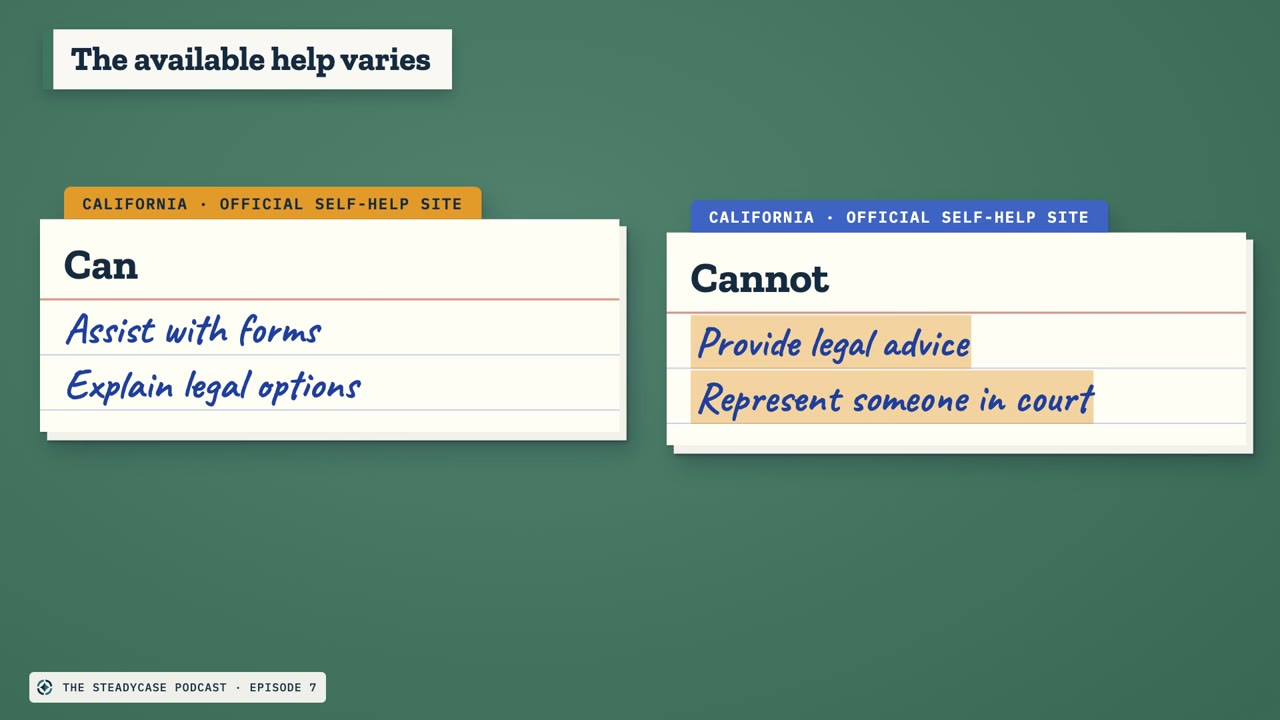
California’s official self-help site, for example, explains that its self-help centers can assist with forms and explain legal options, but cannot provide legal advice or represent someone in court. It also says that services vary among courts.

Once you locate the information, save the source or its address and record the date.
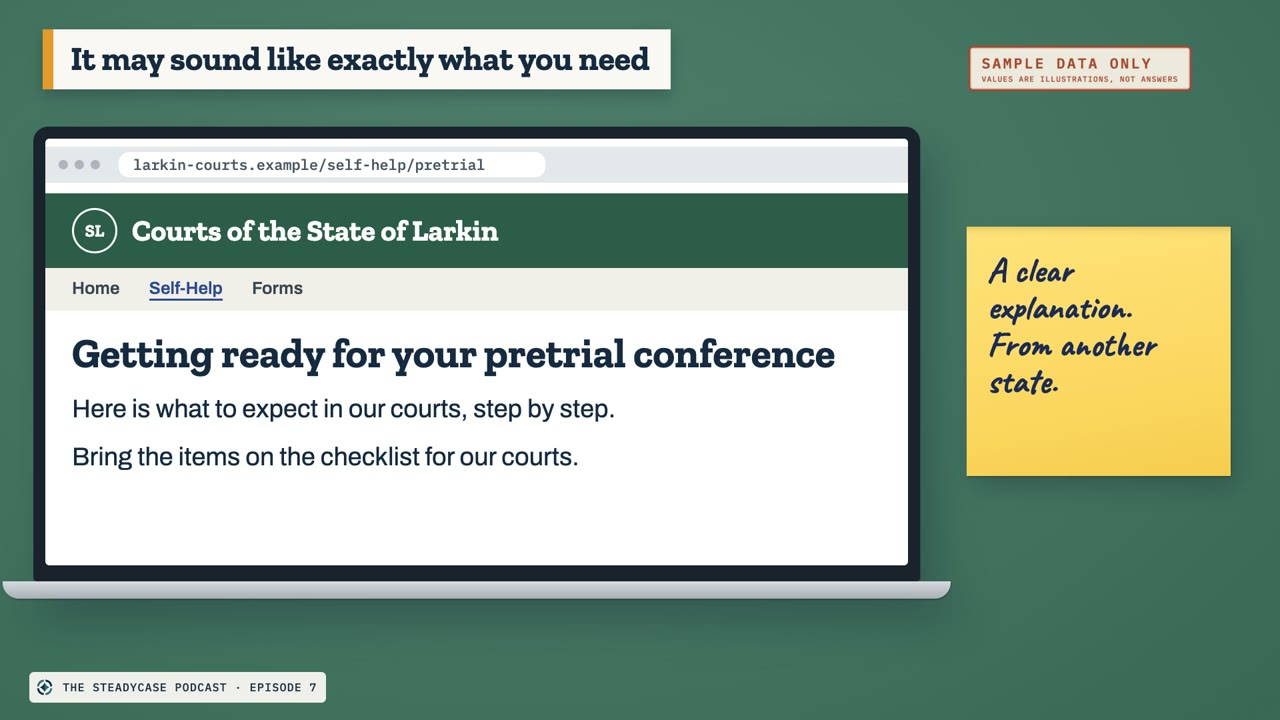
A fictional court web page from the State of Larkin titled Getting ready for your pretrial conference, beside a sticky note reading A clear explanation. From another state. Marked Sample data only.
Sample data only. A fictional page from another state.
Two cards labeled California, official self-help site. Can: assist with forms, explain legal options. Cannot: provide legal advice, represent someone in court.
California’s self-help centers, as described on the official site.

A made-up example: Jordan’s notice

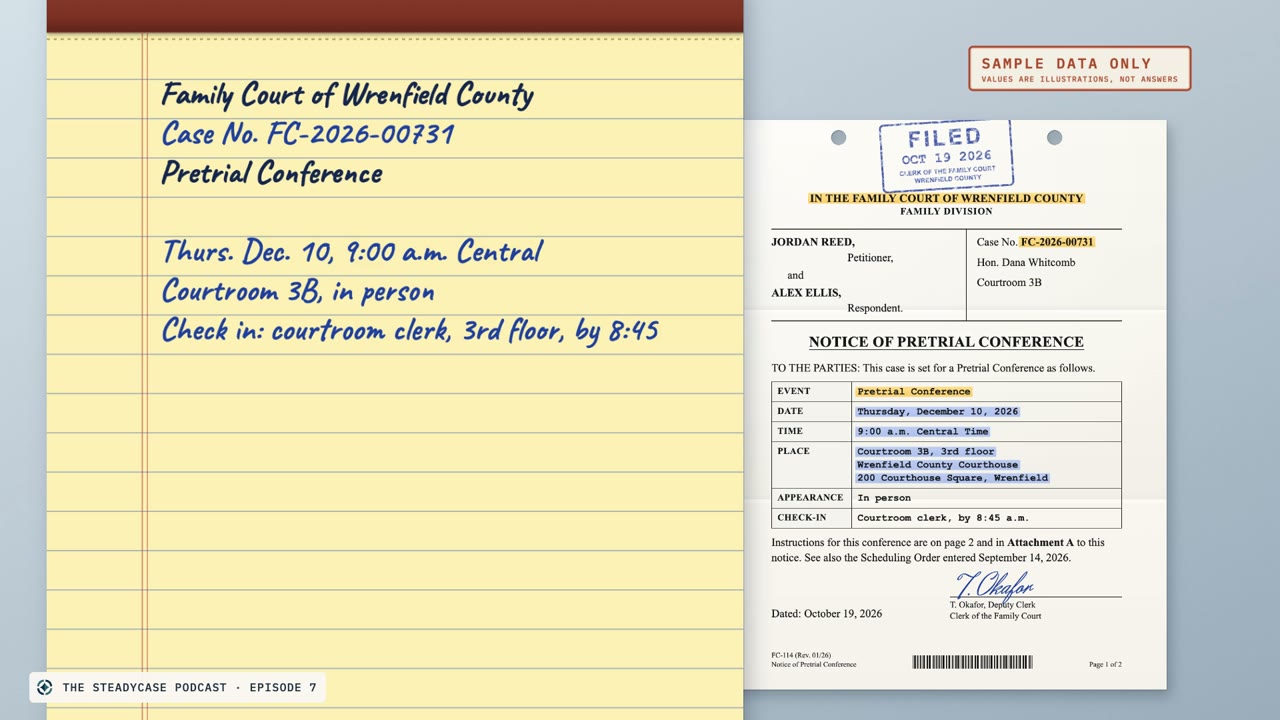
Every person and detail in this example is fictional. Jordan receives a notice headed “Pretrial Conference” and copies the court, case number, event name, and appearance information into a short note.

Then Jordan reads the remaining page and notices a reference to an attachment. The attachment isn’t among Jordan’s papers. Instead of filling that gap from an unrelated internet checklist, Jordan contacts the clerk’s office using the number on the court’s official website and asks how to obtain the referenced document.

Once Jordan obtains the attachment, it stays with the notice. Any directions and dates from that document get their own entries, each with a reference to the original page. Jordan also records any remaining questions.

The example doesn’t tell us the outcome of the conference. It shows a smaller, useful result. Jordan now has the documents describing the event and a clear record of the information that still needs confirmation.

A yellow legal pad with Jordan's handwritten notes of the court, case number, event, date, courtroom, and check-in, beside the fictional notice. Marked Sample data only.
Sample data only. Jordan’s short note.

The method for any court date

Before assembling a working packet, identify the event by its exact name. Read the complete notice and every referenced document. Keep the appearance details separate from the preparation instructions, and leave each date attached to its label.

A calendar entry tells you when. The notice and your court’s instructions explain the event. Once you understand the event, episode 2, A Working Packet for Your Court Date, covers organizing the materials for that appearance.

Sources discussed in this episode

For a custody court date

Our Quick Guide, Your Custody Hearing, includes a Notice Decoder and a Court-Date Event Sheet. Those pages provide structured places for information from your notice and official court sources. Plain paper also works for the method on this page.

See Your Custody Hearing

Common questions

Is a pretrial conference the same as a trial?

They have different purposes. A pretrial conference can address preparation, disputed issues, and possible agreement. At a trial, the court receives evidence to decide disputed questions. Your court’s own materials describe your exact event.

What should I copy from a court notice into my notes?

The court’s name, the case number, and the exact event name. Add the date and time, the place or method of appearance, and any check-in directions. Then note any preparation instructions and any other document the notice mentions.

Does the date on a filing stamp start a deadline?

Recording a date does not determine which date starts a legal deadline. That can depend on rules, service requirements, and court orders. Keep each date with its label, and confirm deadlines through your court or an attorney licensed in your state.

Where can I find out what happens at my court date?

Begin with the official website of the court named on the notice. If it doesn’t resolve the question, a clerk’s office or court self-help center can be a source of procedural information. For advice about your own situation, talk with an attorney licensed in your state.

Your Custody Hearing

A Quick Guide with a Notice Decoder and a Court-Date Event Sheet, for listeners with a custody court date.

See the guide

Episode 2: A Working Packet for Your Court Date

The next step, once you understand the event.

Go to episode 2
Read the transcript

You know when you have court. You may still have questions about what will happen that day.

The notice says “Pretrial Conference.” You put the date on your calendar. You begin gathering messages and photographs, and thinking about how to explain everything that happened.

Then you look at the notice again. Is this the day for witnesses? Is the judge deciding something? Is there another document you need to read before the conference?

Those are useful questions. Knowing the date is only part of understanding the event.

I'm attorney David Martino, and welcome to The Steadycase Podcast. Today we're talking about the different kinds of family-court dates, and how to use your notice to understand the event on your calendar.

Everything in this episode is general information. It isn't legal advice, and I'm not your attorney. For advice about your own situation, talk with an attorney licensed in your state.

We'll use a few examples from official court sources in California and Massachusetts. Those examples explain the distinctions. Your own court's notice, orders, and instructions supply the details for your event.

In episode two, we talked about a working packet for one court date. Today, we're taking the earlier step. Before you organize that packet, you need a clear description of the event.

Let's start with a status conference or a case-management conference.

The general purpose is to review the progress of the case and determine the next procedural steps. The discussion may concern what remains unfinished and how the case will move toward resolution.

California has a particular event called a family-centered case-resolution conference. The court's rule says this conference is intended to develop a plan for resolving the case. It is not intended as an evidentiary hearing.

That distinction helps explain why the full event name is useful. Someone reading only the word “conference” would miss the more specific description. Someone treating every court date as a trial would miss it, too.

Even so, a conference deserves preparation. The same California rule expects the participants to be familiar with the case and prepared to discuss their positions on the issues. A conference's purpose determines the preparation.

Next is a pretrial conference.

As the name suggests, this is preparation before a trial. In Massachusetts, the domestic-relations rule on pretrial procedure lists several possible subjects. They include narrowing the issues and exploring settlement. The rule also addresses agreements about facts and documents that could reduce the amount of proof needed at trial.

There can be consequences for the later proceedings. That Massachusetts rule provides for an order recording the action taken at the conference and limiting the issues for trial. So “pretrial” does not mean “nothing important happens.”

A settlement conference has a related but more specific focus. Its purpose is to explore whether the parties can resolve some or all of their disagreements through an agreement. Massachusetts's family-court standing order describes that purpose and treats settlement conferences, pretrial conferences, and trials as distinct events.

These descriptions can overlap. A pretrial conference may include a settlement discussion. The particular court's instructions explain the planned event more clearly than a general definition.

Then there are hearings on requests for temporary orders.

California's divorce self-help guide describes a temporary order as a short-term decision while the case is still active. The subjects can include a custody schedule or support. The word “temporary” describes the decision's place in the ongoing case. It doesn't make the subject unimportant to the people involved.

Finally, there is a trial, or an evidentiary hearing on particular disputed questions.

Evidence is central to that kind of event. California's divorce-trial guide describes each side presenting a case through testimony, witnesses, and other evidence. Testimony means speaking under oath. A document or other item offered as evidence is called an exhibit. There are rules governing what the judge can consider.

An evidentiary hearing may focus on a narrower question than the entire case. To understand the scope of a particular event, the notice and related orders need a close read.

This isn't a fixed sequence that every family follows. It is a way to recognize the different purposes behind the names. A date on the calendar could involve planning the next steps, discussing an agreement, or presenting evidence for a decision.

The word “hearing” by itself doesn't supply all those details.

Now let's turn to the notice itself.

A useful starting point is the court's name and the case number. Those details identify the case and the court whose instructions you need.

Then copy the exact event name into your notes. If the notice says “Pretrial Conference,” use those words. A calendar entry that says only “court” is harder to understand a month later.

Next are the appearance details. These include the date and time, and the place or method of appearance. An in-person notice may identify a courthouse and courtroom. A remote notice may refer to connection instructions somewhere else. If a time zone is stated, include it in your notes.

Check-in directions deserve their own line. A link to a remote platform and an instruction about checking in are separate pieces of information.

Then read the rest of the notice. A second page may contain preparation instructions. The first page may refer to an attachment or an earlier scheduling order. A reference to another document is a reason to locate that document, rather than guess about its contents.

It helps to separate the appearance information from the preparation information. One tells you when and how the event takes place. The other describes what the court has directed before or during that event.

Dates need the same care. A filing stamp, the date you received a document, and the date of the appearance describe different facts. Keeping the label beside each date preserves the distinction.

Your notes can also identify the source of each entry. “Appearance time, first page of notice” is more useful than a time copied without context. If you confirm something through an official court resource, record that source and the date of the check.

There will sometimes be a blank in those notes. Perhaps the notice refers to an attachment that wasn't included. Perhaps the remote-appearance instructions are unclear. A useful entry identifies the question and the official source for clarification.

You don't need a special form for this step. A plain sheet of paper can hold the event name, the appearance details, and the questions that still need an answer.

Let's take three questions that follow from this topic. These are examples we've put together for the episode.

The first question is: “My notice says ‘pretrial conference.’ Is that my trial?”

A pretrial conference and a trial have different purposes. The conference can address preparation, disputed issues, and possible agreement. At a trial, the court receives evidence to decide disputed questions.

The Massachusetts rule we discussed makes the distinction concrete. Its pretrial procedure can narrow the questions that remain for trial, and the resulting order can shape the later proceedings.

For your own notice, the useful next step is to find your court's description of that exact event. The notice may identify papers for the conference or refer to a separate order. Those instructions deserve attention even if the event isn't called a trial.

The event name alone also isn't a reliable answer to every preparation question. Whether witnesses will testify, what documents are required, and which issues are scheduled need confirmation in the court's own materials.

A search for “pretrial conference” can return information about criminal cases, civil lawsuits, and family cases. Adding the court's name and “family court” helps narrow the search. The result still needs a check against the court and case type on your notice.

The aim is a specific description of your scheduled event. “Pretrial conference in this court, with these published instructions” gives you a much clearer starting point than the single word “court.”

The second question is: “The papers have several dates. Which one goes on my calendar?”

There may be more than one useful calendar entry.

The appearance date gets its exact event name. If the papers expressly give a separate date for a preparation requirement, that date gets its own entry, with the court's wording and the source.

The filing date and the date you received the papers remain in your records with their own labels. Recording those facts does not determine which date starts a legal deadline.

That's the distinction to keep clear. Copying a date is an organizational step. Determining the deadline that applies to a particular filing may require checking rules, service requirements, and court orders.

For example, your notes might say “date on filing stamp” on one line and “date received by mail” on another. Neither line should silently become “response due.” That would add a legal conclusion that wasn't in the original entry.

The same principle applies when something appears inconsistent. If two documents seem to list different appearance details, keep both documents and identify the discrepancy for confirmation. Guessing about which one controls can leave the uncertainty hidden in your calendar.

Court staff or a self-help center may be able to point you to the applicable procedural information. When the answer requires legal advice about your own circumstances, an attorney licensed in your state can help you evaluate that question.

Meanwhile, a complete record of the papers and their dates gives you a precise question for that conversation.

The third question is: “The notice tells me when to appear, but not what happens that day. How can I find out?”

Begin with the court named on the notice. Its official website may have a family-law section, information for people without attorneys, or instructions for the named event.

A page from another court can explain a general term. It doesn't establish the instructions for your appearance.

The distinction is especially useful with search results. A clear explanation from another state may sound like exactly the answer you need. Before relying on its procedure, check the court's name and the kind of case it covers.

If the official materials don't resolve the question, a clerk's office or court self-help center can be a source of procedural information within the services that office provides.

A specific question helps. “Where are the published instructions for this type of conference?” identifies the information you need. “Does the court have a preparation checklist for this event?” is another useful question. For appearance details, the question might be, “Where can I confirm the location or the remote-access instructions?”

The available help varies. California's official self-help site, for example, explains that its self-help centers can assist with forms and explain legal options, but cannot provide legal advice or represent someone in court. It also says that services vary among courts.

That is a useful distinction between information about the process and advice about a position in your own case. A procedural question asks where to find the instructions. A strategy question asks what you should request or argue given your circumstances.

Once you locate the information, save the source or its address and record the date. That makes the explanation easier to find again when you prepare for the appearance.
Here's a made-up example of the method.

Jordan receives a notice headed “Pretrial Conference.” Jordan copies the court, case number, event name, and appearance information into a short note.

Then Jordan reads the remaining page and notices a reference to an attachment. The attachment isn't among the papers Jordan received.

Instead of filling that gap from an unrelated internet checklist, Jordan contacts the clerk's office using the number on the court's official website and asks how to obtain the referenced document.

Once Jordan obtains the attachment, it stays with the notice. Any directions and dates from that document get their own entries, each with a reference to the original page. Jordan also records any remaining questions.

The example doesn't tell us how the conference will end. It shows a smaller, useful result. Jordan now has the documents describing the event and a clear record of the information that still needs confirmation.
Before assembling a working packet, identify the event by its exact name. Read the complete notice and the documents it references. Keep the appearance details separate from the preparation instructions, and leave each date attached to its label.

For listeners with a custody court date, our Quick Guide, Your Custody Hearing, includes a Notice Decoder and a Court-Date Event Sheet. Those pages provide structured places for information from your notice and official court sources. The guide is at getsteadycase.com/custody-hearing. The link will be in the episode notes.

You can also use plain paper for the method we covered today. Once you understand the event, episode two, A Working Packet for Your Court Date, covers organizing the materials for that appearance.

If this episode was useful, follow The Steadycase Podcast in your podcast app, or subscribe on YouTube.

Have a topic you'd like us to cover? Email [email protected]. Please leave out the details of your own case.

A calendar entry tells you when. The notice and your court's instructions explain the event. Thanks for listening.