Your Custody Hearing
A practical field guide to the notice, the courtroom, and what may happen next. It helps you identify the event named on your papers, orient yourself to common courtroom mechanics, verify local procedure, and leave with an accurate court-date record.
Five parts, in the order a court date unfolds.
“Court date” is an umbrella. The guide starts with the papers, walks through the room and the people in it, explains what happens when evidence is taken, and ends with the tools for keeping an accurate record. Thirty-seven numbered sections across 67 numbered pages.
Fields drawn from your own papers, not from guesses.
Each worksheet asks you to copy what the notice, the orders, and official sources actually say, and to write UNKNOWN / ASK instead of filling a gap with a guess. Print the pages you need and fill them in by hand.
Three labels mark how a point can vary: a broad explanation of how a process commonly works, a common practice that may change with the court or judicial officer, and a requirement that belongs in a current official source.
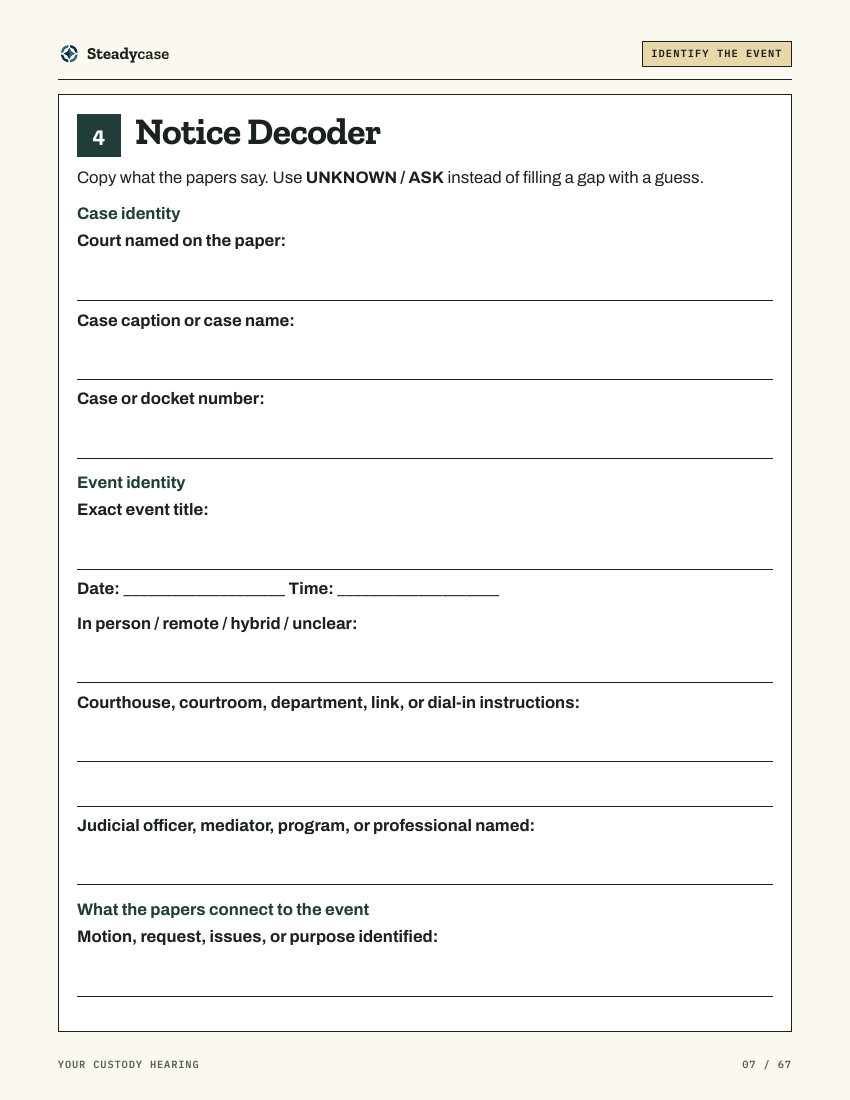
- Notice DecoderCase identity, event identity, and what the papers connect to the event, copied from the notice itself.
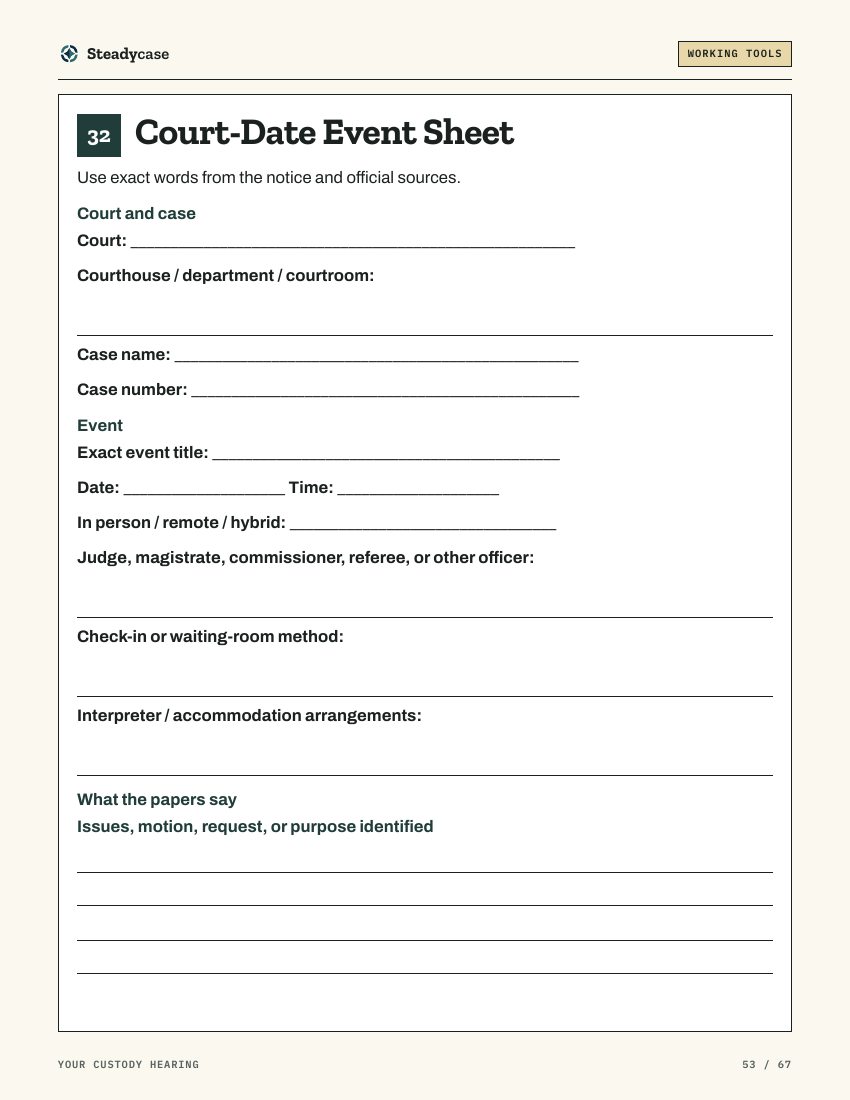
- Court-Date Event SheetThe court, case, event, date, appearance method, judicial officer, and check-in method, in the exact words of the notice and official sources.
- Presentation MapRecords the procedure the court permits: whether evidence will be taken, the issues stated, and the sequence. It does not select a legal position or strategy.
- Outcome SheetWho appeared, what was addressed, and what the court said, in the words recorded, kept separate from proposed papers and entered orders.
- Terms and directions recordA place for the court’s exact terms and directions, so nothing rests on memory.
- Courtroom phrasebook and glossaryCommon courtroom phrasing and terminology, explained in plain language.
- Find the official sourceA search sequence that puts the court handling the case at the center, with a source record for each answer and the date it was checked.
Three of the pages, exactly as they print.
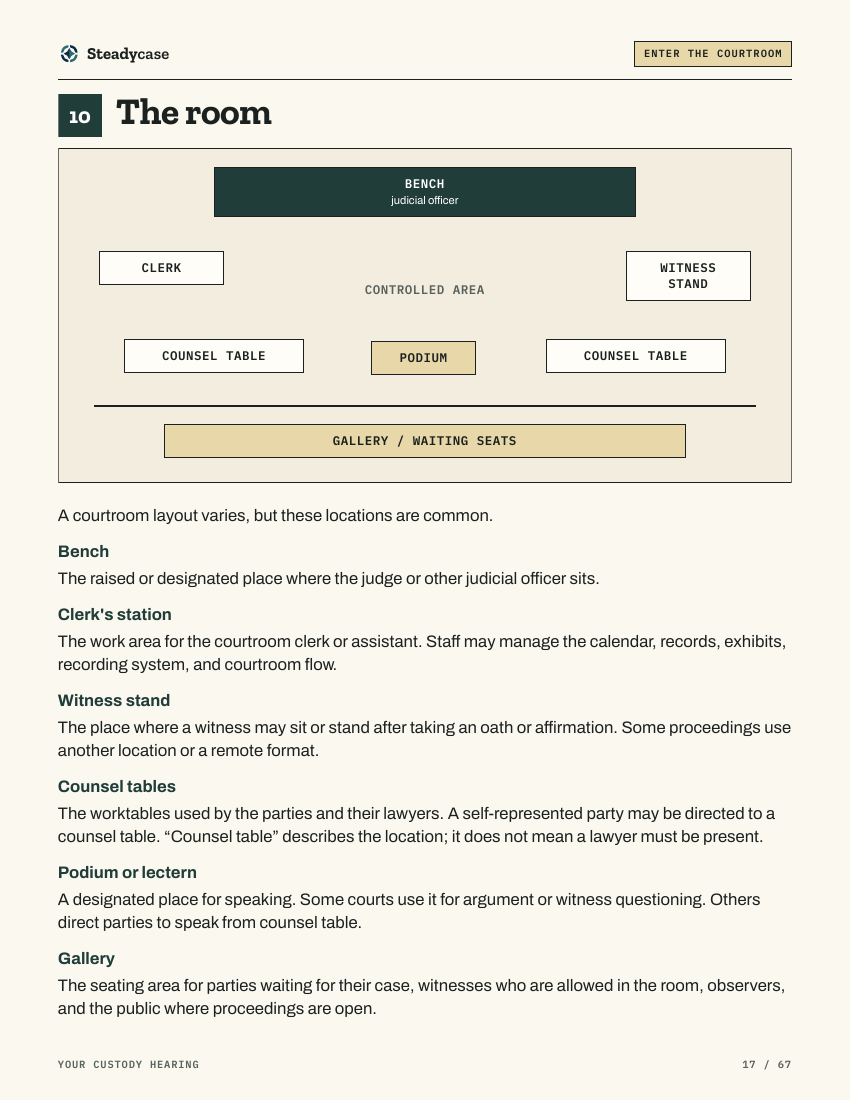
The Notice Decoder, the courtroom diagram, and the Court-Date Event Sheet you fill in by hand.
The guide explains the event. It never tells you what to argue.
The guide points to official sources and to legal help at different levels. It does not apply the law to your facts, predict what a judge will decide, or tell you what to file, request, say, or argue. A lawyer can do what this guide cannot. For advice about your own case, consult an attorney licensed in the state where the case is pending.