Podcast › Episode 6

How to Put a Holiday Custody Trade in Writing

Episode 6: Holiday Time, Written Down

By David Martino14:48November 12, 2026

Legal information, not legal advice. Listening doesn't create an attorney-client relationship, and reading this page doesn't create one either. Court rules vary by state and court.

The question

How do I keep a holiday agreement with the other parent clear and written down?

Audio only
Also in your podcast appApple PodcastsSpotifyYouTubeRSS feed

It’s the Wednesday before Thanksgiving. You and the other parent settled the holiday plan weeks ago, by text. You remember that plan clearly. The other parent remembers it clearly, too. The two versions are different.

Somewhere in a long thread sits the message that settled the plan. Finding it means scrolling past a month of school pickups, photos, and grocery questions. A plan made in October can be hard to find in late November.

Episode 6 of The Steadycase Podcast brings the recordkeeping habits from earlier episodes to the holidays. This page walks through the method, one made-up example, and three typical questions.

Three separate pieces of information

Holidays come on fixed dates. Plans for them are often made weeks in advance, and usually by text. A holiday can also involve travel, family visiting from out of town, and an exchange at an unusual hour. That leaves three separate pieces of information.

  1. The court order or parenting plan, and what it says about each holiday.
  2. Any agreement the two parents make on their own, outside that order. This often takes the form of a text, an email, or a verbal conversation.
  3. A record of what actually took place on the holiday.

The agreements come first here, because they cause most holiday trouble.
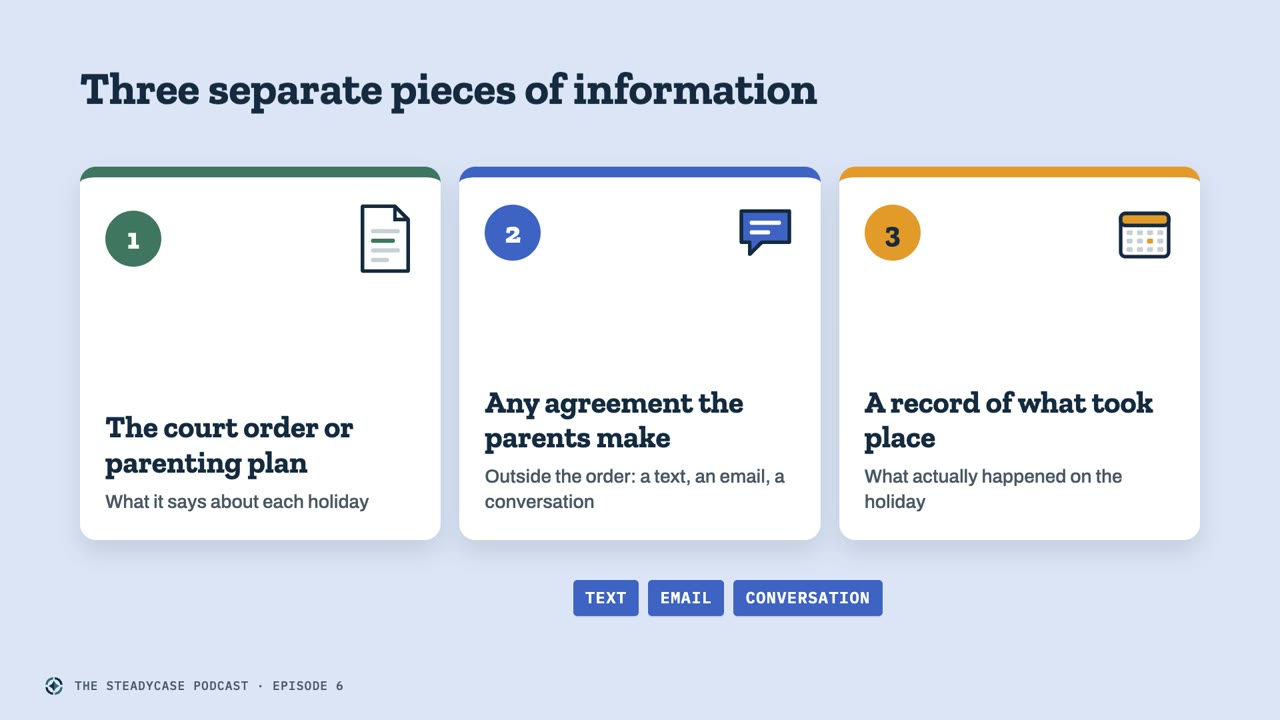
Slide titled Three separate pieces of information, with three numbered cards. One, the court order or parenting plan. Two, any agreement the parents make. Three, a record of what took place. Tags below read Text, Email, Conversation.
The three pieces of holiday information.

Put the trade in writing, with every term

Parents change the holiday schedule all the time. One parent’s family is coming in from out of state. The other parent wants to travel over winter break. They make a trade. That kind of flexibility can be good for everyone, including the children.

If you and the other parent agree to change the holiday schedule, put the agreement in writing. A plan made out loud, on a doorstep or over the phone, is only two people’s memories. Months later, those memories are rarely the same.

The writing should cover all the terms. Name the holiday and the dates. Include the start and end times, the exchange place, and the driver.
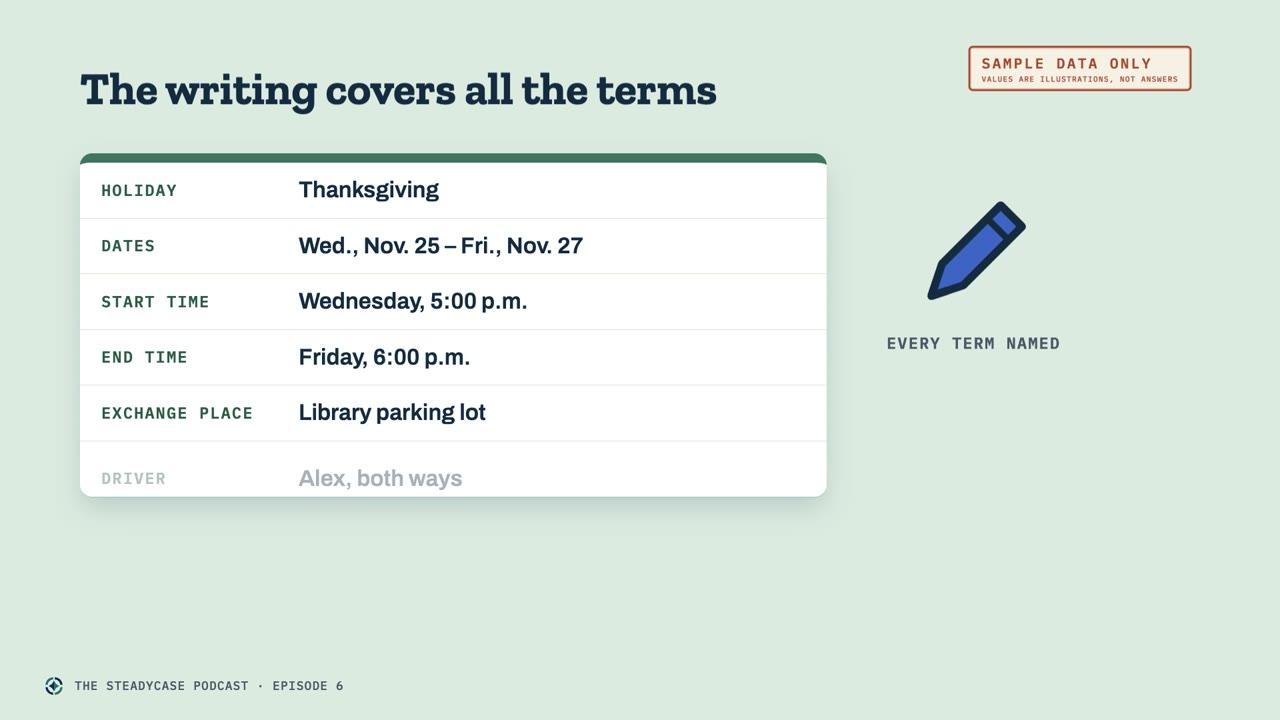
Slide titled The writing covers all the terms. A card lists the holiday, Thanksgiving; the dates, Wednesday, November 25 to Friday, November 27; the start time, Wednesday, 5:00 p.m.; the end time, Friday, 6:00 p.m.; the exchange place, the library parking lot; and the driver. Marked Sample data only.
Sample data only. Every term named.

Include what each parent gets in return

Suppose one parent gives up Thanksgiving so the other parent’s family can see the children. Maybe the parent giving up Thanksgiving gets the next spring break in exchange. If that’s the deal, the writing should say so, and it should say which spring break.

A trade with only half its terms in writing can cause trouble later. With the whole deal written down, nobody has to rely on memory when spring break comes. The terms are there, in both parents’ own words. If a disagreement about it ever reaches court, you have that agreement in writing.

A clear yes, saved with the whole conversation

The strongest version is a formal written agreement that the court approves. More on that below. If the agreement is made by text or email, make sure the thread shows both parents’ own words, including a clear yes.

Then save the whole conversation, the way episode 4 did, and add one log line that points to the saved file.
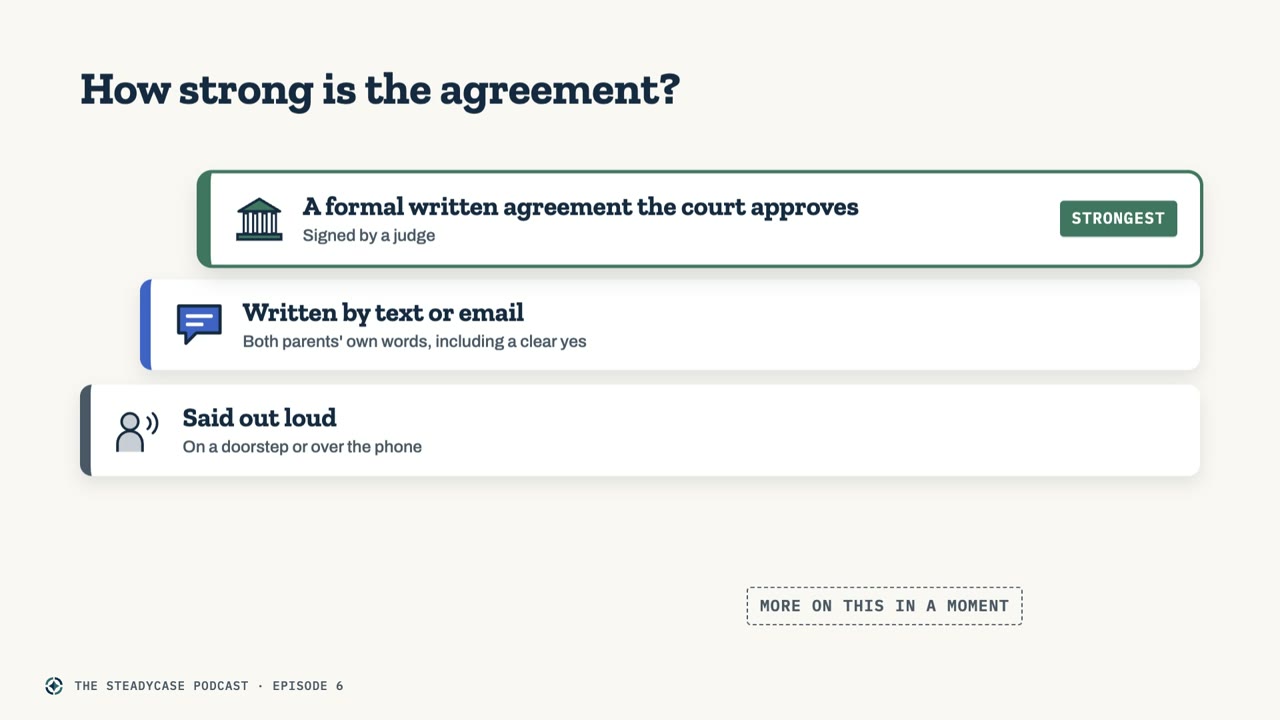
Slide titled How strong is the agreement? Three rungs rise from Said out loud, on a doorstep or over the phone, to Written by text or email, both parents' own words including a clear yes, to the top rung, A formal written agreement the court approves, signed by a judge, tagged Strongest.
From a spoken plan to a court-approved agreement.

An agreement between parents usually isn’t a court order

An agreement between parents usually isn’t the same as a court order. Michigan Legal Help, a free statewide legal information site, puts it this way: “Even if you both agree to change custody or parenting time, the current order is in effect until the judge signs a new order.”

California’s court self-help site explains the same idea: “A judge has to sign the agreement before it can be filed.”

So, for a change to have the force of a court order, the agreement generally needs a judge’s signature. Your court’s clerk or self-help center can explain how parents in your court submit an agreement for approval. The written agreement you already saved is a natural starting point.
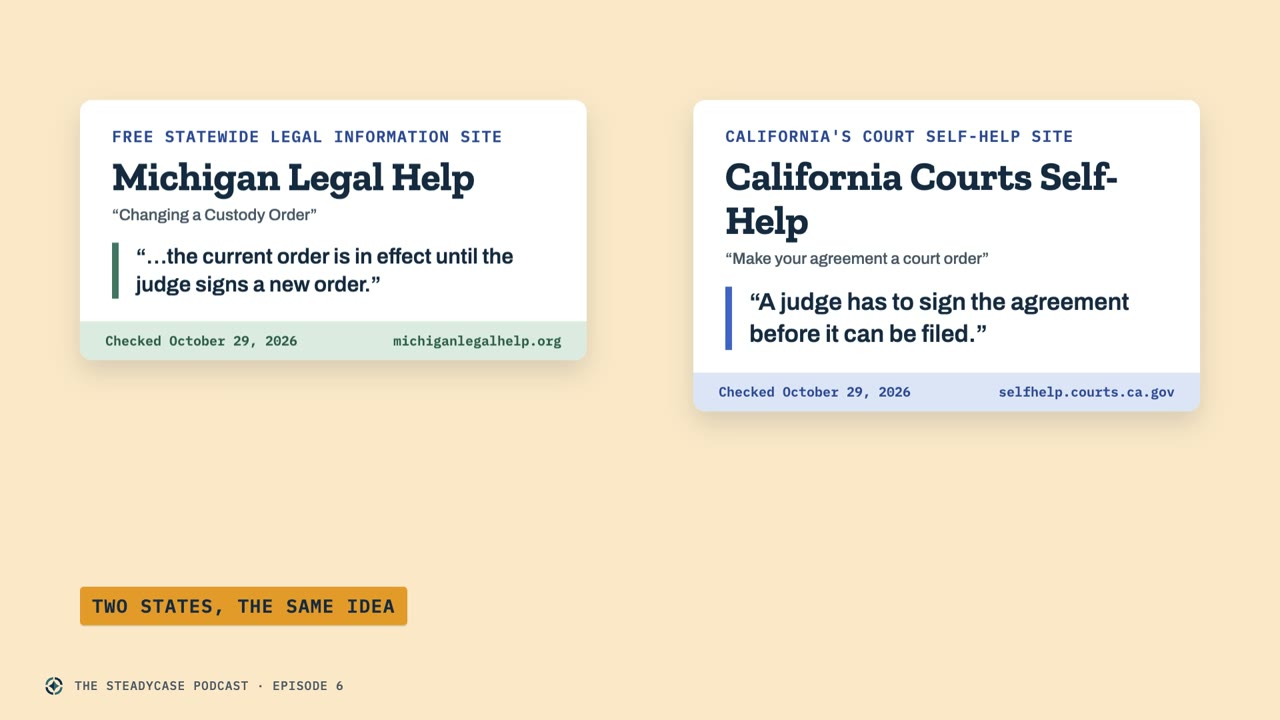
Two source cards side by side. Michigan Legal Help, Changing a Custody Order: the current order is in effect until the judge signs a new order. California Courts Self-Help, Make your agreement a court order: A judge has to sign the agreement before it can be filed. A tag reads Two states, the same idea.
Two self-help sites, the same idea.

Copy the order’s holiday wording

Find the holiday wording in the court order and copy it word for word into your notes. Add where it appears, such as the page and paragraph number. If a holiday you care about isn’t mentioned, write that down, too. “The court order doesn’t mention Halloween” is a plain fact.

You’re saving the exact words so you don’t have to dig out the whole document before every holiday.
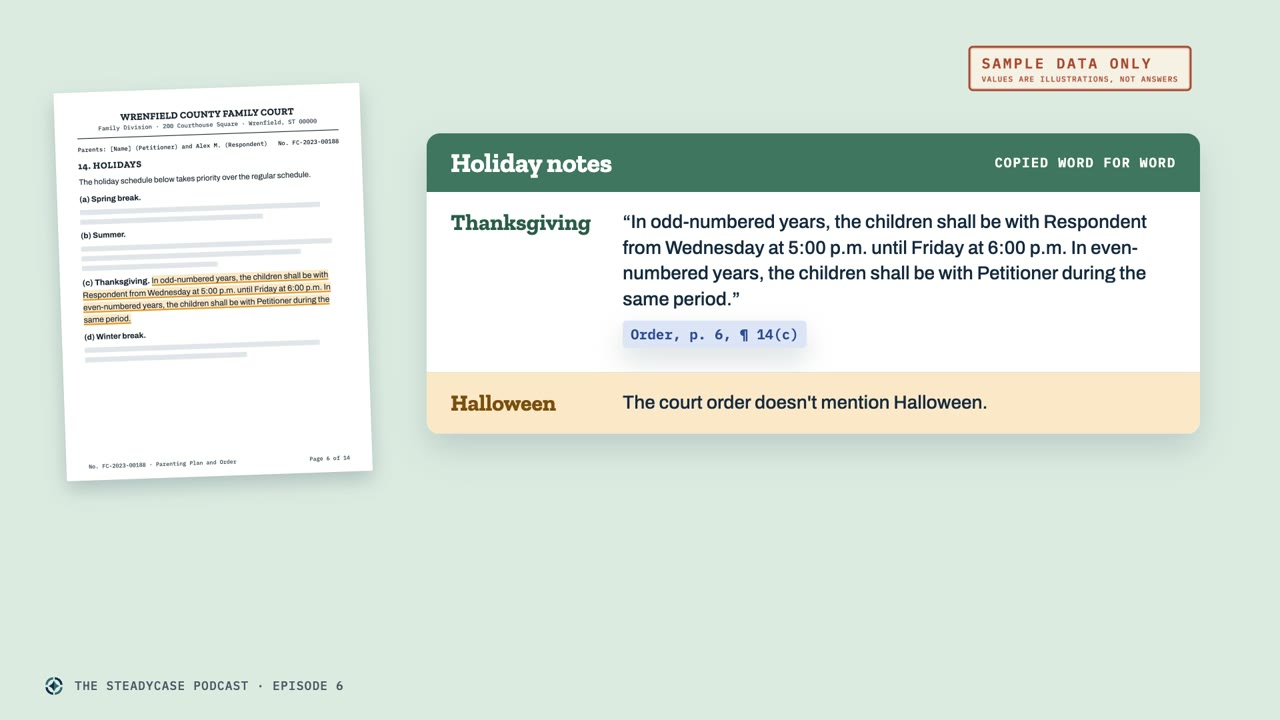
A fictional order page beside a Holiday notes card. The Thanksgiving row quotes the order's sentence word for word with its citation, Order, page 6, paragraph 14(c). A Halloween row reads The court order doesn't mention Halloween. Marked Sample data only.
Sample data only. The order’s words, with page and paragraph.

After the holiday, a short entry with facts only

Write a short entry the next day, while the details are fresh. Keep it to facts. Include the time of the exchange, the place, and the people present. If a message came in that day, note where it’s saved.

The free Document Everything Method guide puts the difference simply. A useful log line sounds like a fact. A weak log line sounds like a verdict.

A made-up example: the Thanksgiving trade

This example follows the parent from earlier episodes, the one who texts with Alex, the children’s other parent. Every person and detail in it is fictional.

On October 30, Alex texts and asks for Thanksgiving, so Alex’s parents can see the children. The court order gives Alex Thanksgiving in odd-numbered years, so this year, an even-numbered year, Thanksgiving belongs to the parent, not Alex. After a few messages, they work out a trade.

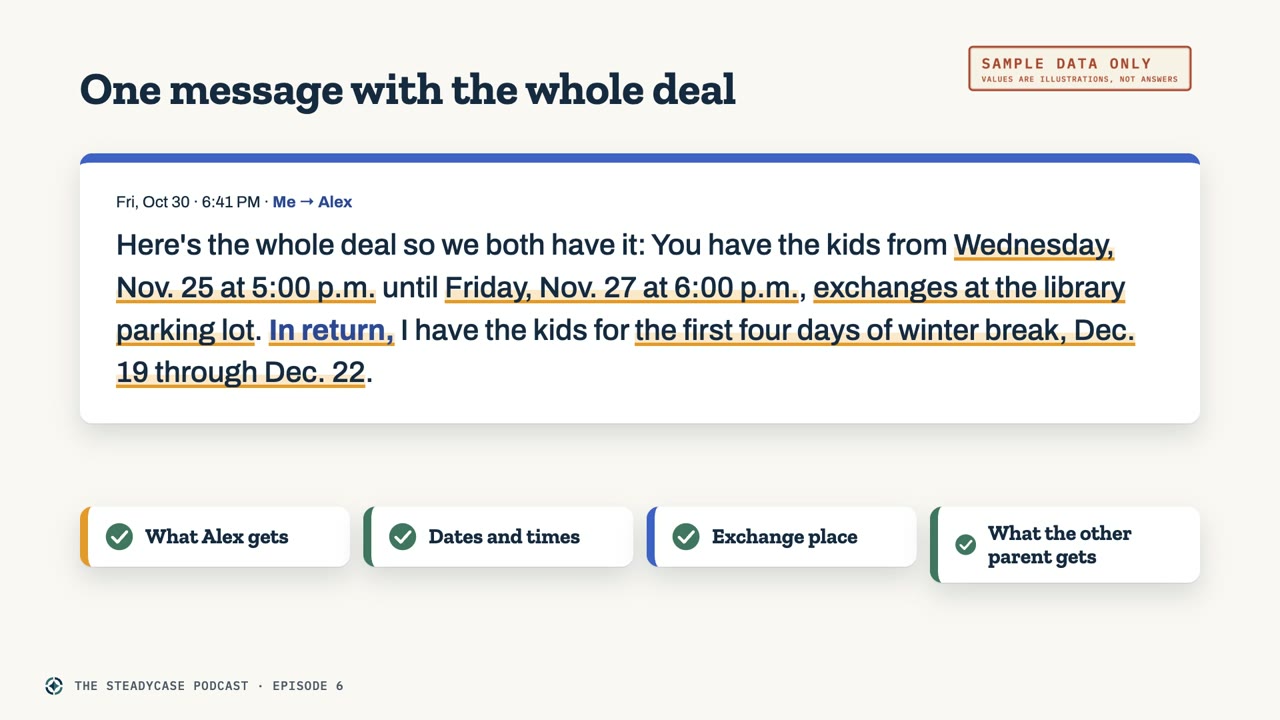
The parent sends one message that sets out the whole deal. Alex has the children from Wednesday at 5 until Friday at 6, with exchanges at the library parking lot. In return, the parent has the children for the first four days of winter break, from December 19 through December 22. Alex replies, “Agreed.”

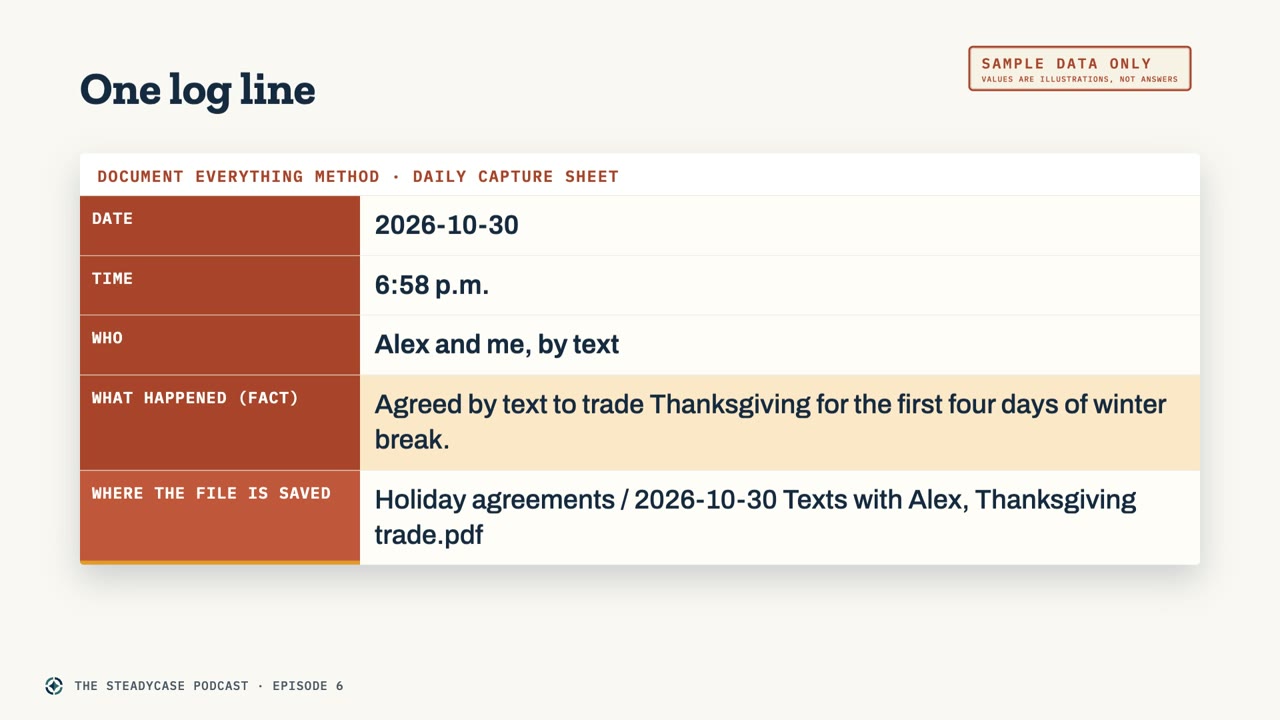
That evening, the parent saves the conversation and adds one log line: “Agreed by text to trade Thanksgiving for the first four days of winter break.” The date has its own space. The space for where the file is saved holds the folder and the file name.

The parent also copies the order’s Thanksgiving sentence into their notes, with the page and paragraph number. Now the order’s terms and the trade share one place.
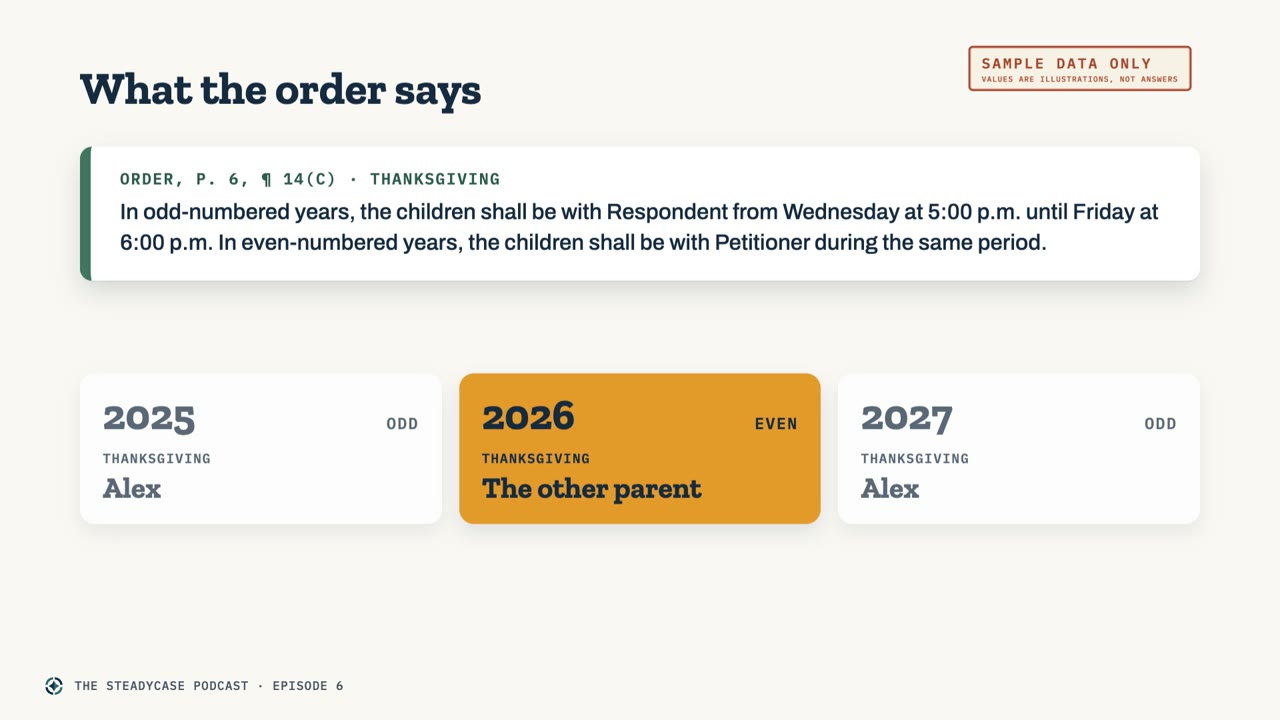
Slide titled What the order says. The order's Thanksgiving sentence above three year tiles: 2025, odd, Alex; 2026, even, the other parent, highlighted; 2027, odd, Alex. Marked Sample data only.
Sample data only. The order alternates Thanksgiving by year.
Slide titled One message with the whole deal. The message from Me to Alex on Friday, October 30 at 6:41 PM sets out Wednesday, November 25 at 5:00 p.m. until Friday, November 27 at 6:00 p.m., exchanges at the library parking lot, and in return the first four days of winter break, December 19 through December 22. Four checked chips read What Alex gets, Dates and times, Exchange place, What the other parent gets. Marked Sample data only.
Sample data only. One message carries every term.
Slide titled One log line. A capture-sheet record dated 2026-10-30, 6:58 p.m., Alex and me, by text, Agreed by text to trade Thanksgiving for the first four days of winter break, with the file saved at Holiday agreements / 2026-10-30 Texts with Alex, Thanksgiving trade.pdf. Marked Sample data only.
Sample data only. One log line that points to the saved file.

Thanksgiving week, and the entry the next day

The return is planned for Friday at 6, at the library parking lot. At ten minutes to six, Alex texts about running twenty minutes late. The children arrive at 6:25.

On Saturday morning, the parent writes a short entry: “Friday return at the library lot, 6:25. Alex texted at 5:50 about running late.” The entry also notes where that text is saved.

The entry doesn’t describe anyone’s mood or take sides. It records a time, a place, and a saved message. In December, the first four days of winter break are already spelled out, in both parents’ words. Nobody has to reconstruct the deal from memory.
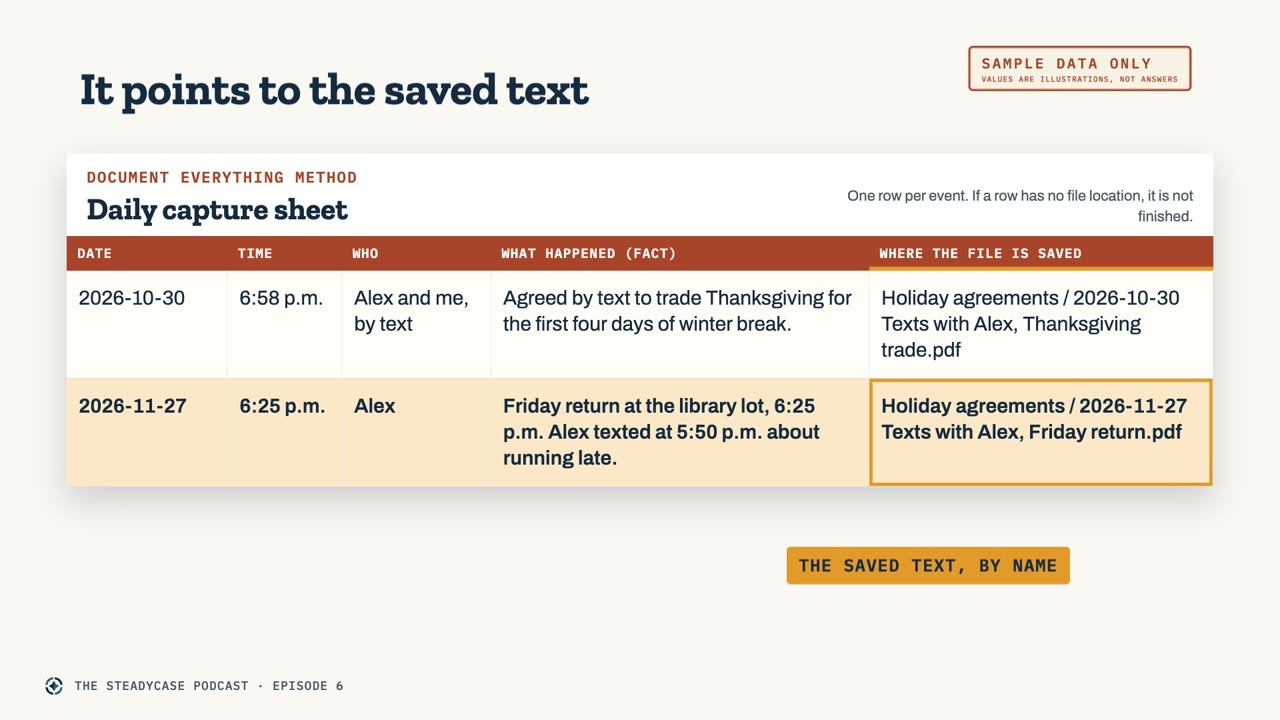
Slide titled It points to the saved text. A daily capture sheet with two rows: the October 30 trade and the November 27 return at 6:25 p.m., with the Where the file is saved cell outlined, reading Holiday agreements / 2026-11-27 Texts with Alex, Friday return.pdf. Marked Sample data only.
Sample data only. The entry points to the saved text.

When the schedule you follow drifts from the order

One typical question from social media: “The order looks clear on paper, but day to day, we’ve drifted into a completely different schedule. What do I do?”

This is very common. Children change schools, parents change jobs, and schedules shift with those changes. The order on paper often stays the same.

Even when both parents agree to a different schedule, the court order usually stays in effect until a judge signs a new one. If both parents are comfortable with the schedule they actually follow, they can put it in writing as an agreement and ask the court to approve it. Your court’s self-help center can explain the process.

In the meantime, keep a record of both. Copy the order’s schedule in its own words. Also keep a plain, dated calendar of the schedule you actually followed, with the days and the exchanges. Holidays make a natural starting point, because each one already has a date.
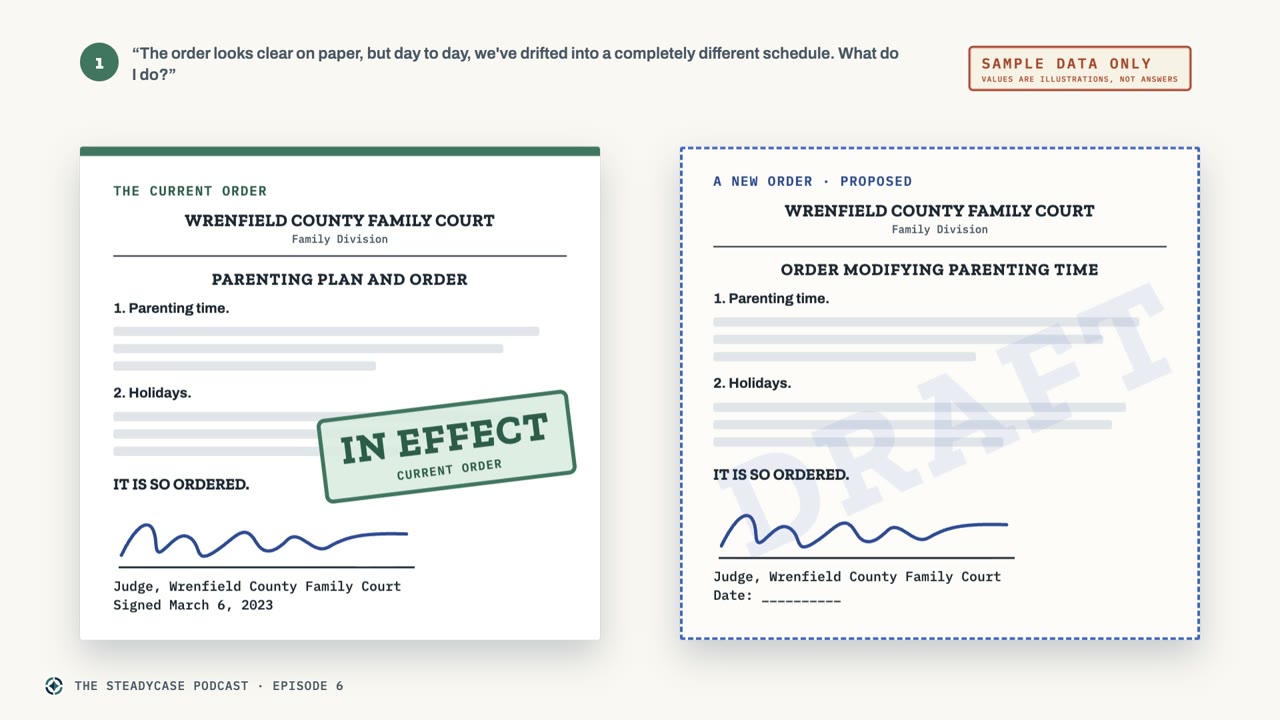
Two fictional documents. The current order, Parenting Plan and Order, signed and stamped In effect. Beside it, a proposed Order Modifying Parenting Time marked Draft, shown at the moment a judge signs it. Marked Sample data only.
Sample data only. The current order stays in effect until a judge signs a new one.

When a holiday is missing from the paper

A second typical question: “My ex asked to take the kids for Thanksgiving and Christmas this year. Our agreement says I have Thanksgiving, but there’s nothing on paper for Christmas. What do I do?”

Here the agreement is the written custody agreement, not a text or a conversation, so in your notes it gets the same treatment as the order. Copy the Thanksgiving wording exactly, with the page and paragraph. Then note that the agreement doesn’t mention Christmas.

Whatever you decide about the request, answer it in writing, and save the whole conversation. If you agree to give up Thanksgiving, write down what you’re getting in return, the way the fictional parent did.

Christmas is the bigger issue here, because when a holiday is missing from the paper, parents end up negotiating it again each December. Many parents in that situation work out a holiday schedule, put it in writing, and submit it to the court for approval. That way, next year’s Christmas doesn’t start from scratch.
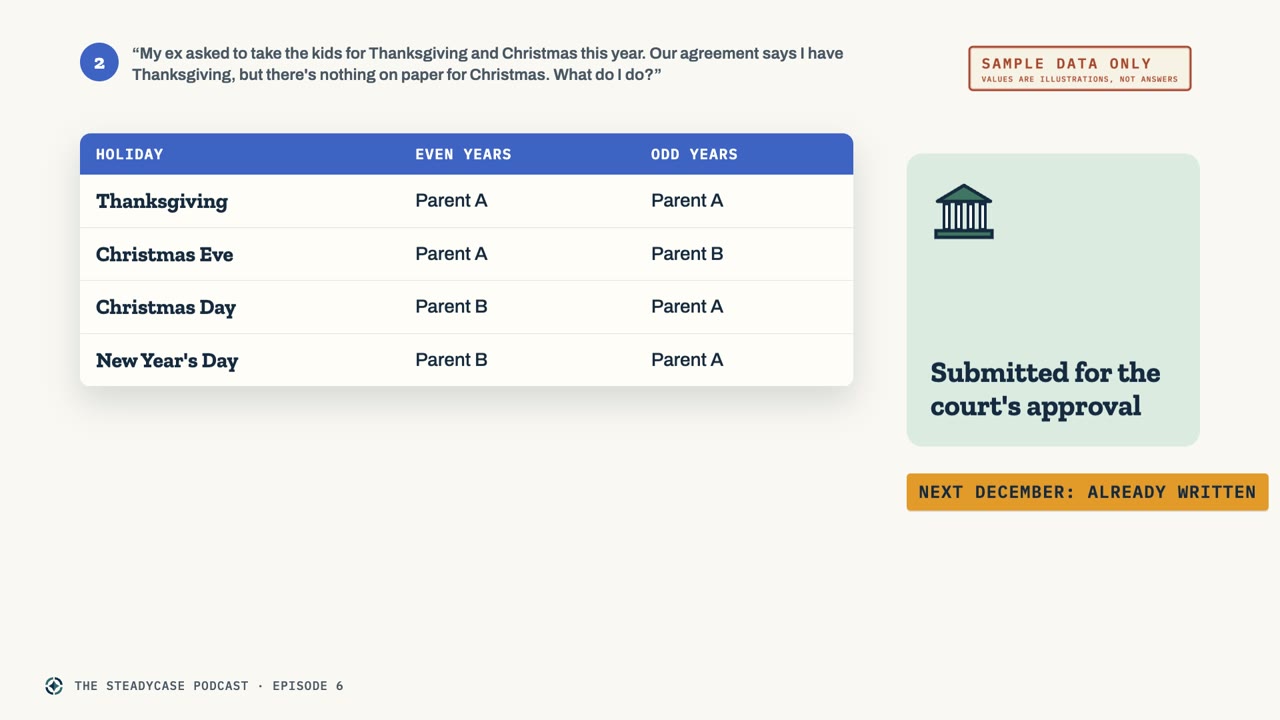
A holiday schedule table with even-year and odd-year columns for Thanksgiving, Christmas Eve, Christmas Day and New Year's Day, assigned to Parent A or Parent B, beside a card reading Submitted for the court's approval and a tag reading Next December: already written. Marked Sample data only.
Sample data only. A written holiday schedule, submitted for approval.

When an agreed plan is dropped the day before

A third typical question: “We agreed on a holiday plan that was different from the court order. The day before my time, my co-parent said she wasn’t going to follow it. What can I do?”

This question shows why the writing and the court’s approval carry so much weight. An agreement made outside the court order generally isn’t a court order. Whether a court in your state would enforce an informal agreement depends on your state and your facts. If possible, consult an attorney about your situation, or use the self-help resources in your state. Steadycase Compass, our state-by-state map of official sources, points you to your state’s court self-help and legal-aid resources.

In the meantime, write one dated entry, the same day or the next, with facts only. Note what had been agreed and where that agreement is saved. Note what was said, when it was said, and where that message is saved. Then note what took place instead. If changing the order ever comes up, that record gives you dates and details, not just memories.

Going forward, a holiday plan that both parents want to rely on belongs in a written agreement, signed off on by the court.

The method for any holiday change

When you and the other parent agree to change a holiday, put every term in writing, including what each of you gets. Save the whole conversation, and add a log line that points to the saved file. Keep the court order’s own words in your notes. After each holiday, write a short, factual entry. For a change that should carry the force of an order, ask your court how to get the agreement approved.

The free Document Everything Method has the log page behind this habit, including the space for where the file is saved: getsteadycase.com/document-everything.
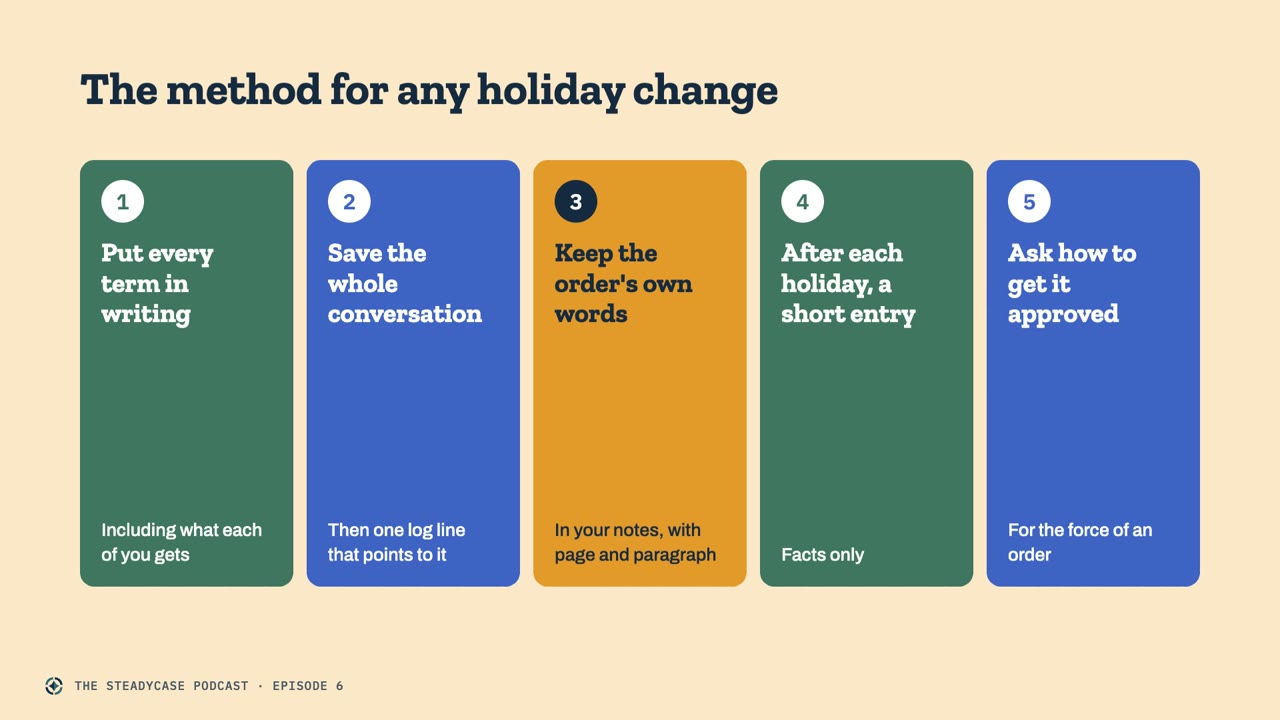
Slide titled The method for any holiday change, with five numbered cards. One, put every term in writing. Two, save the whole conversation. Three, keep the order's own words. Four, after each holiday, a short entry. Five, ask how to get it approved.
The five-step method from the episode.

Sources discussed in this episode

One place for the whole custody case

The Custody Trial Notebook keeps a custody case in one structured place, with its own section for each part of the case, including a timeline and a parenting-time log. $69 for the spreadsheet edition (Excel or Google Sheets) or $49 for the fillable Print Edition. One time, either way.

See the Custody Trial Notebook

Going through a divorce? See the Divorce Trial Notebook

Common questions

Is a text agreement with the other parent the same as a court order?

Usually not. An agreement between parents usually isn’t the same as a court order. Michigan Legal Help says the current order is in effect until the judge signs a new order, and California’s court self-help site says a judge has to sign the agreement before it can be filed. For a change to have the force of a court order, the agreement generally needs a judge’s signature. Your court’s clerk or self-help center can explain the process.

What should a written holiday agreement include?

All the terms. Name the holiday and the dates. Include the start and end times, the exchange place, and the driver. Then include what each parent gets in return, specific enough that nobody has to guess, such as which spring break.

What goes in a log entry after a holiday exchange?

Facts only, written the next day while the details are fresh. Include the time of the exchange, the place, and the people present. If a message came in that day, note where it’s saved. A useful log line sounds like a fact, not a verdict.

Where can I find my state’s court self-help resources?

Your court’s clerk or self-help center is a good first stop. Steadycase Compass, a state-by-state map of official sources, points to each state’s court self-help and legal-aid resources. For advice about your own situation, talk with an attorney licensed in your state.

Document Everything Method

The log page behind this habit, as a free guide.

Get the free guide

Custody Trial Notebook

$69 digital edition or $49 Print Edition, one time.

See the notebook

Steadycase Compass

Official-source maps for family court, state by state.

See Compass

Keep the Whole Thread

Free companion guide for iPhone and Android.

Get the free guide
Read the transcript

It's the Wednesday before Thanksgiving. You and the other parent settled the holiday plan weeks ago, by text. You remember that plan clearly.

The other parent remembers it clearly, too.

The two versions are different.

Somewhere in a long thread, there's the message that settled the plan. Finding that message means scrolling past a month of school pickups, photos, and grocery questions.

A plan made in October can be hard to find in late November.

I'm attorney David Martino, and welcome to The Steadycase Podcast. This show offers general legal information for everyone listening and practical ways to keep your records organized.

The holidays are coming. In my more than thirty years as an attorney, I've seen how often the holidays bring unexpected problems for separated parents. Plans change at the last minute. Travel gets booked before anyone checks the schedule. A holiday turns out to be missing from the court order altogether.

Today, we're going to talk about some of the issues that come up around the holidays, and what you can do to keep the plan clear and written down.

Everything in this episode is general information. It isn't legal advice, and I'm not your attorney. Every family and every court is different. For advice about your own situation, talk with an attorney licensed in your state. If you can't afford an attorney for your whole case, many attorneys offer a consultation limited to one issue. Court self-help centers, legal aid offices, and pro bono programs in your community can help, too.

With that said, let's get to the holidays.

In our first episode, we started a short dated log that points to each record. In episode four, we saved a whole text conversation as a dated file. Last time, we talked about checking what an AI tool says against the source document. Today we're bringing those habits to the holidays.

Holidays come on fixed dates. Plans for them are often made weeks in advance, and usually by text. A holiday can also involve travel, family visiting from out of town, and an exchange at an unusual hour.

That leaves three separate pieces of information. The first is the court order or parenting plan, and what it says about each holiday. The second is any agreement the two parents make on their own, outside that order. This often comes in the form of a text, an email, or a verbal conversation. The third is a record of what actually took place on the holiday.

Let's start with the agreements, because they're the source of most holiday trouble.

Parents change the holiday schedule all the time. One parent's family is coming in from out of state. The other parent wants to travel over winter break. They make a trade. That kind of flexibility can be good for everyone, including the children.

If you and the other parent agree to change the holiday schedule, put the agreement in writing. A plan made out loud, on a doorstep or over the phone, is only two people's memories. Months later, those memories are rarely the same.

The writing should cover all the terms. Name the holiday and the dates. Include the start and end times, the exchange place, and the driver.

Then include what each parent gets in return. Suppose one parent gives up Thanksgiving so the other parent's family can see the children. Maybe the parent giving up Thanksgiving gets the next spring break in exchange. If that's the deal, the writing should say so, and it should say which spring break.

A trade with only half its terms in writing can cause trouble later. With the whole deal written down, nobody has to rely on memory when spring break comes. The terms are there, in both parents' own words. If a disagreement about it ever reaches court, you have that agreement in writing.

The strongest version is a formal written agreement that the court approves. I'll come back to that in a moment. If the agreement is made by text or email, make sure the thread shows both parents' own words, including a clear yes. Then save the whole conversation, the way we did in episode four, and add one log line that points to the saved file.

There's one more important piece of general information about these agreements. An agreement between parents usually isn't the same as a court order. Michigan Legal Help, a free statewide legal information site, says that even when both parents agree to change parenting time, the current order stays in effect until a judge signs a new order. California's court self-help site explains the same idea. A judge has to sign an agreement before it becomes a court order.

So, for a change to have the force of a court order, the agreement generally needs a judge's signature. Your court's clerk or self-help center can explain how parents in your court submit an agreement for approval. The written agreement you already saved is a natural starting point.

Now, the other two pieces of information.

First, the court order. Find the holiday wording and copy it word for word into your notes. Add where it appears, such as the page and paragraph number. If a holiday you care about isn't mentioned, write that down, too. “The court order doesn't mention Halloween” is a plain fact.

You're saving the exact words so you don't have to dig out the whole document before every holiday.

Second, the holiday itself. Write a short entry the next day, while the details are fresh. Keep it to facts. Include the time of the exchange, the place, and the people present. If a message came in that day, note where it's saved.

The free Document Everything Method guide puts the difference simply. A useful log line sounds like a fact. A weak log line sounds like a verdict.

Let's follow the parent from our earlier episodes, the one who texts with Alex. This is a made-up example.

On October thirtieth, Alex texts and asks for Thanksgiving, so Alex's parents can see the children. The court order gives Alex Thanksgiving in odd-numbered years, so this year, an even-numbered year, Thanksgiving is the parent's. After a few messages, they work out a trade.

The parent sends one message that sets out the whole deal. Alex has the children from Wednesday at five until Friday at six, with exchanges at the library parking lot. In return, the parent has the children for the first four days of winter break, from December nineteenth through the twenty-second. Alex replies, “Agreed.”

That evening, the parent saves the conversation. Then they add one log line. “Agreed by text to trade Thanksgiving for the first four days of winter break.” The date goes in its own space. In the space for where the file is saved, they write the folder and the file name.

The parent also copies the order's Thanksgiving sentence into their notes, with the page and paragraph number. Now the order's terms and the trade are in one place.

Then comes Thanksgiving week. The return is planned for Friday at six, at the library parking lot. At ten minutes to six, Alex texts about running twenty minutes late. The children arrive at six twenty-five.

On Saturday morning, the parent writes a short entry. “Friday return at the library lot, six twenty-five. Alex texted at five fifty about running late.” The entry also notes where that text is saved.

The entry doesn't describe anyone's mood or take sides. It records a time, a place, and a saved message.

In December, the first four days of winter break are already spelled out, in both parents' words. Nobody has to reconstruct the deal from memory.

Now let's turn to three questions. We've been looking at what parents post on social media, and these are three typical questions we've been seeing about the holidays.

One reminder before we start. These answers are general information. For legal advice about your own situation, talk with an attorney, or start with your court's self-help center.

The first question: “The order looks clear on paper, but day to day, we've drifted into a completely different schedule. What do I do?”

This is very common. Children change schools, parents change jobs, and schedules shift with those changes. The order on paper often stays the same.

Keep in mind the general point from earlier. Even when both parents agree to a different schedule, the court order usually stays in effect until a judge signs a new one. If both parents are comfortable with the schedule they actually follow, they can put it in writing as an agreement and ask the court to approve it. Your court's self-help center can explain the process.

In the meantime, keep a record of both. Copy the order's schedule in its own words. Also keep a plain, dated calendar of the schedule you actually followed, with the days and the exchanges. Holidays are a natural place to start, because each one already has a date.

The second question: “My ex asked to take the kids for Thanksgiving and Christmas this year. Our agreement says I have Thanksgiving, but there's nothing on paper for Christmas. What do I do?”

In this question, the agreement is the written custody agreement, not a text or a conversation, so in your notes it gets the same treatment as the order. Start by copying the Thanksgiving wording exactly, with the page and paragraph. Then note that the agreement doesn't mention Christmas.

Whatever you decide about the request, answer it in writing, and save the whole conversation. If you agree to give up Thanksgiving, write down what you're getting in return, the way our fictional parent did.

Christmas is the bigger issue here, because when a holiday is missing from the paper, parents end up negotiating it again each December. Many parents in that situation work out a holiday schedule, put it in writing, and submit it to the court for approval. That way, next year's Christmas doesn't start from scratch.

The third question: “We agreed on a holiday plan that was different from the court order. The day before my time, my co-parent said she wasn't going to follow it. What can I do?”

This question shows why the writing and the court's approval are so important. An agreement made outside the court order generally isn't a court order. Whether a court in your state would enforce an informal agreement depends on your state and your facts. If possible, consult an attorney about your situation, or use the self-help resources in your state. Steadycase Compass, our state-by-state map of official sources, points you to your state's court self-help and legal-aid resources.

In the meantime, here is what you can do right away. Write one dated entry, the same day or the next, with facts only. Note what had been agreed and where that agreement is saved. Note what was said, when it was said, and where that message is saved. Then note what took place instead. If changing the order ever comes up, that record gives you dates and details, not just memories.

Going forward, a holiday plan that both parents want to rely on belongs in a written agreement, signed off on by the court.

Here's the method to remember for any change to the regular holiday schedule. When you and the other parent agree to change a holiday, put every term in writing, including what each of you gets. Save the whole conversation, and add a log line that points to the saved file. Keep the court order's own words in your notes. After each holiday, write a short, factual entry. For a change that should carry the force of an order, ask your court how to get the agreement approved.

The free Document Everything Method guide has the log page behind this habit, including the space for where the file is saved. It's at getsteadycase.com/document-everything.

If you want one place for the whole custody case, the Custody Trial Notebook includes a timeline and a parenting-time log. It's at getsteadycase.com/custody. Those links, along with Steadycase Compass and Keep the Whole Thread from episode four, are in this episode's notes.

If this episode was useful, follow The Steadycase Podcast in your podcast app, or subscribe on YouTube. Then each new episode reaches you on its release day. Following also helps other parents find the podcast.

Have a topic you'd like us to cover? Email [email protected]. Please leave out the details of your own case.

Before the next holiday, look at your plan. If any part of the plan is only in someone's memory, put it in writing. Thanks for listening.