It’s late. A letter from the court has been read three times, and one paragraph still makes no sense. A chatbot is open on the phone. You could ask what a legal term means, upload the letter, or ask the chatbot to write your response.
Those are different requests. Each one gives the tool a different amount of information and a different role in your case. Episode 5 of The Steadycase Podcast follows what happens when a copy of a case record goes to an online AI service, and how to check the answer. This page walks through the method, one made-up example, and five common questions.
Three questions before you press send
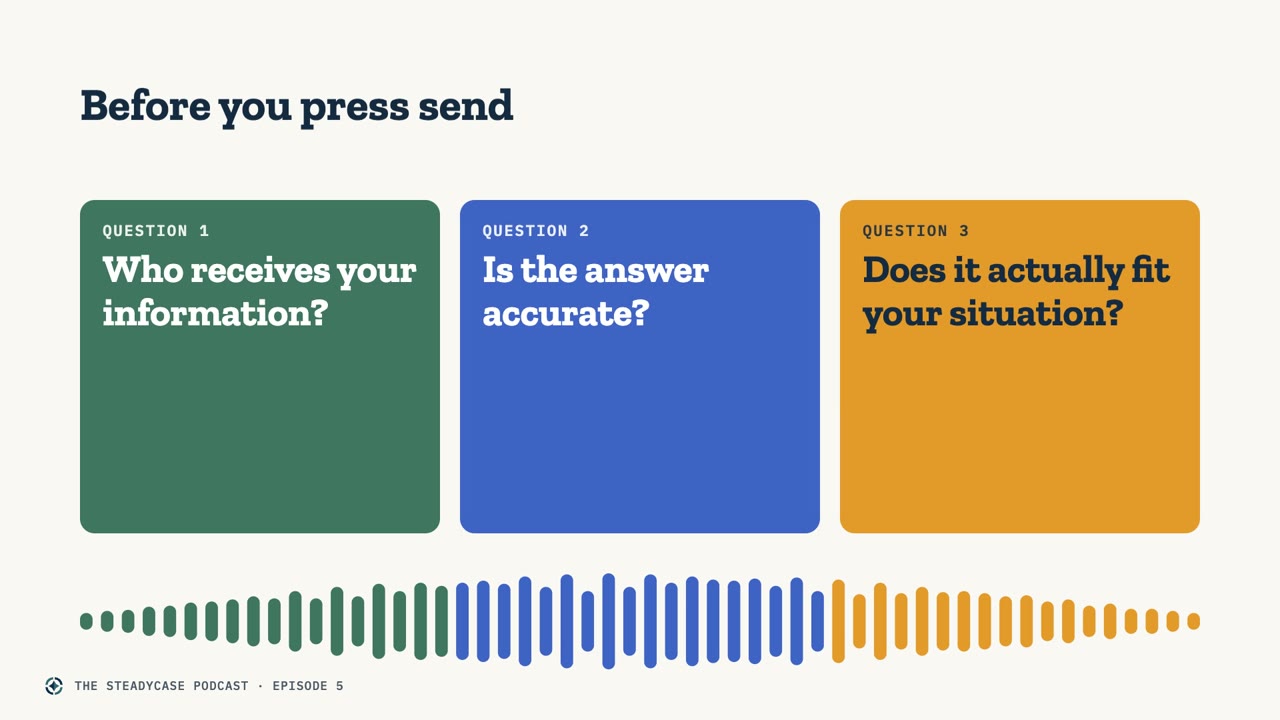
Before sending anything, separate three questions.
- Who receives your information?
- Is the answer accurate?
- Does it actually fit your situation?
Producing a clear sentence and establishing that the sentence is correct are separate steps. A tool can do the first without the second.
What the research shows
Clio’s 2025 survey of 1,000 U.S. adults found that 14 percent had used AI to answer legal questions. That figure covers legal questions generally. It does not say how many parents use chatbots during custody cases.
A newer UK study looked at the conversations themselves. Among participants who reported a recent legal dispute, about one in six had used a chatbot for help. Some of the questions concerned family law. Some people already had lawyers and asked a chatbot to explain or check what a lawyer had told them.
The two studies cover different populations, and neither gives a national count of American custody litigants using AI. They do document something recognizable. People seek explanations, drafting help, and reassurance during legal problems.
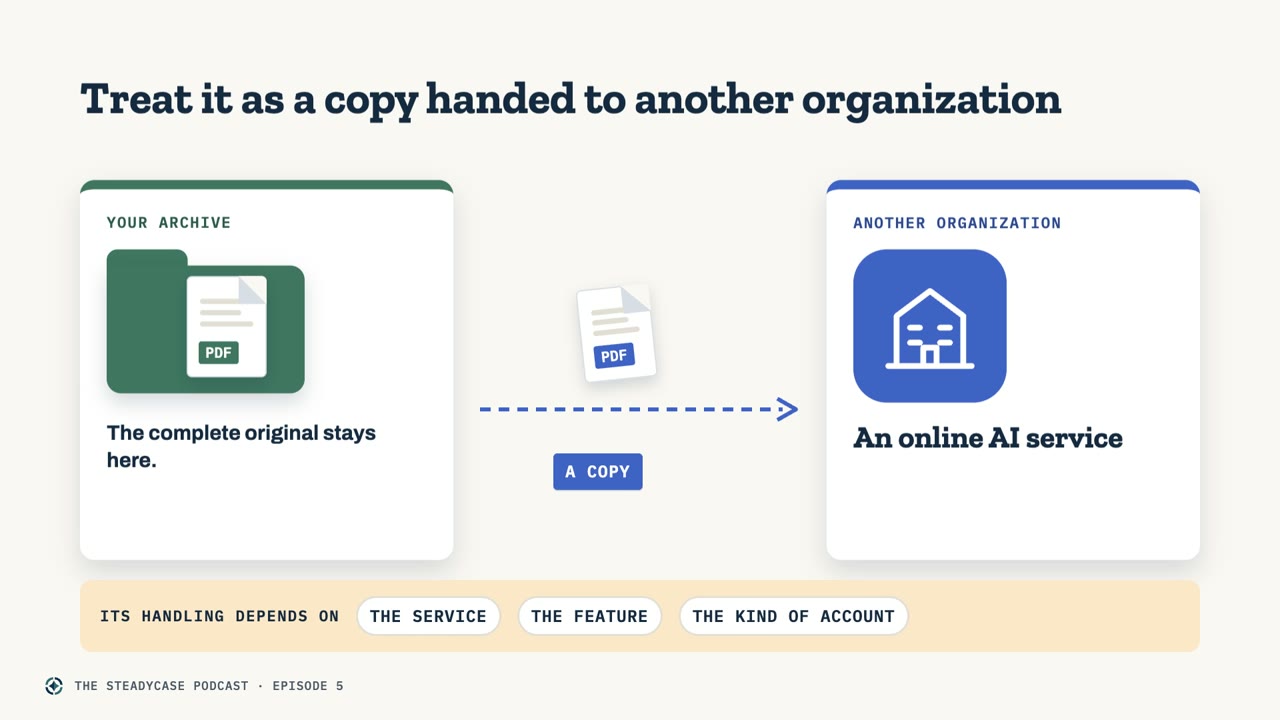
An upload is a copy handed to another organization
When you send a file to an online service, treat it as a copy handed to another organization. Its handling depends on the service, the feature, and the kind of account.
For example, one large AI company’s consumer privacy page says human reviewers examine some chats. The company warns against entering confidential information that someone wouldn’t want a reviewer to see. Reviewed chats can be kept for up to three years, even after the user deletes their activity.
Other services and account types have different arrangements. One provider says it doesn’t use business-service or API inputs and outputs for model improvement by default. Its consumer accounts have different settings.
That distinction is important when AI is built into another app. The consumer chatbot’s policy may not describe the arrangement that app has with the provider.
Connecting a chatbot to an outside service can also mean sharing information with another organization. Check both the chatbot’s privacy policy and the connected service’s policy, including each one’s terms for receiving and keeping information.
These examples come from policies checked in October 2026. Policies change, so check the current terms for the particular service and feature.
Training is only one question
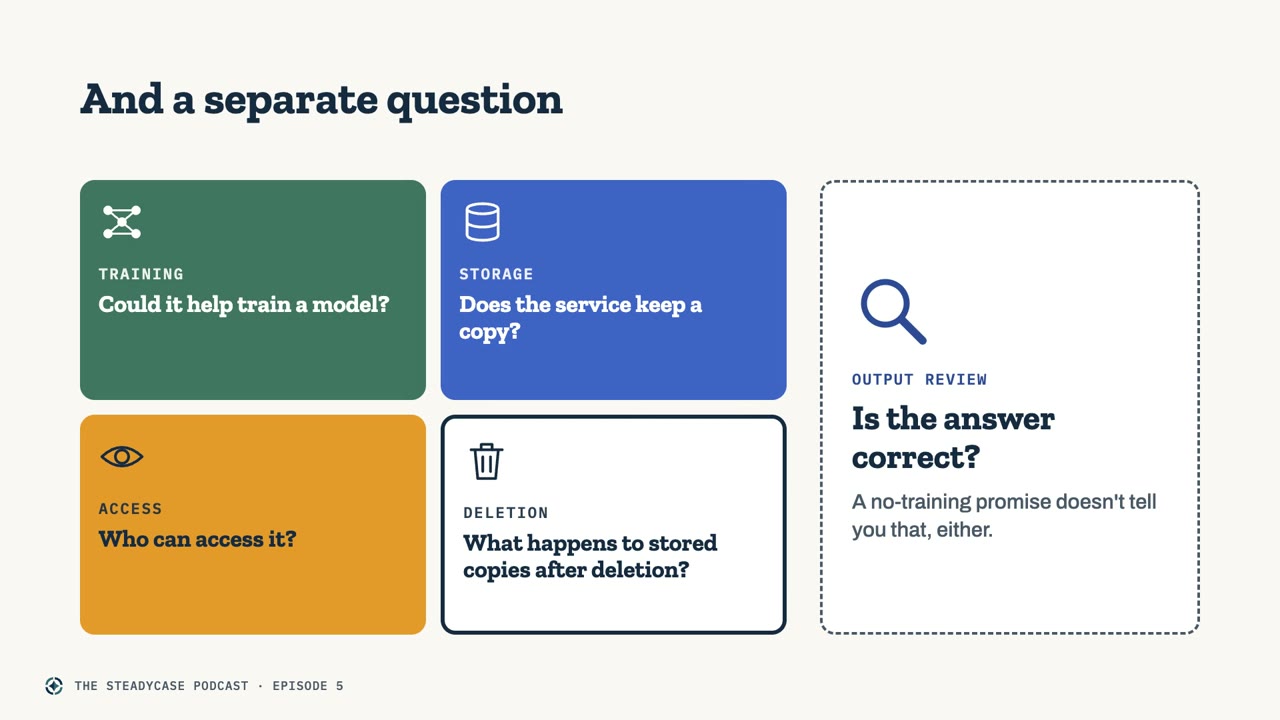
A promise that your information won’t train a model leaves other questions open. Does the service keep a copy? Who can access it? What happens to stored copies after deletion or account closure? The same promise says nothing about whether the answer is correct.
The American Bar Association asks lawyers using these tools to examine their terms and confidentiality risks. That guidance is written for lawyers, yet the underlying questions are useful for anyone considering an upload.
A court order can impose restrictions beyond a company’s privacy policy. Having a document in your files does not settle whether you may send it to an outside service. Court rules, orders, and any restrictions on the records need separate attention. A self-help center can help locate court resources, and a lawyer can explain how restrictions apply to particular documents.
Covering words is different from removing them
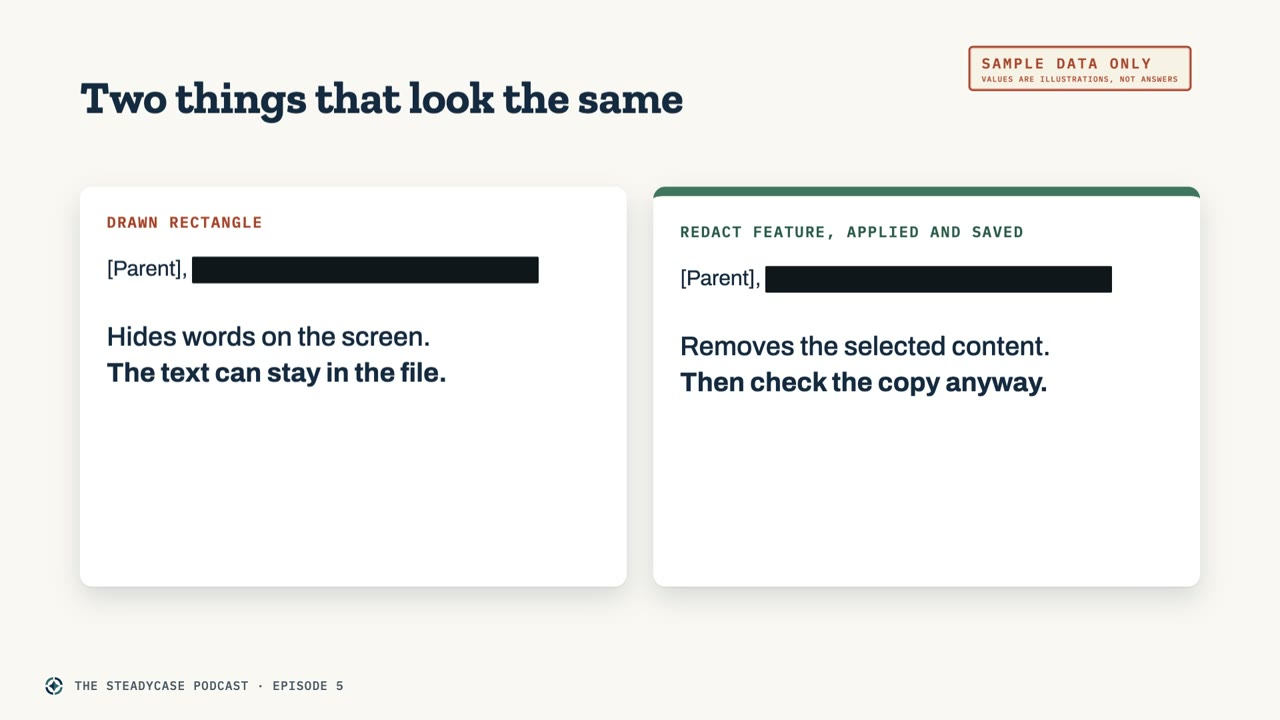
Two federal courts warn that drawing a box over text, changing its color, or using certain PDF commenting tools can leave information recoverable. Proper redaction removes the information. A black rectangle on the screen does not establish that removal.
A rectangle drawn in a PDF editor is different from that editor’s Redact feature. The rectangle may hide words on the screen while leaving them in the file. A proper Redact feature removes the selected content when you apply and save the change. The file may still contain other sensitive details or hidden information, so check the copy before sharing it.
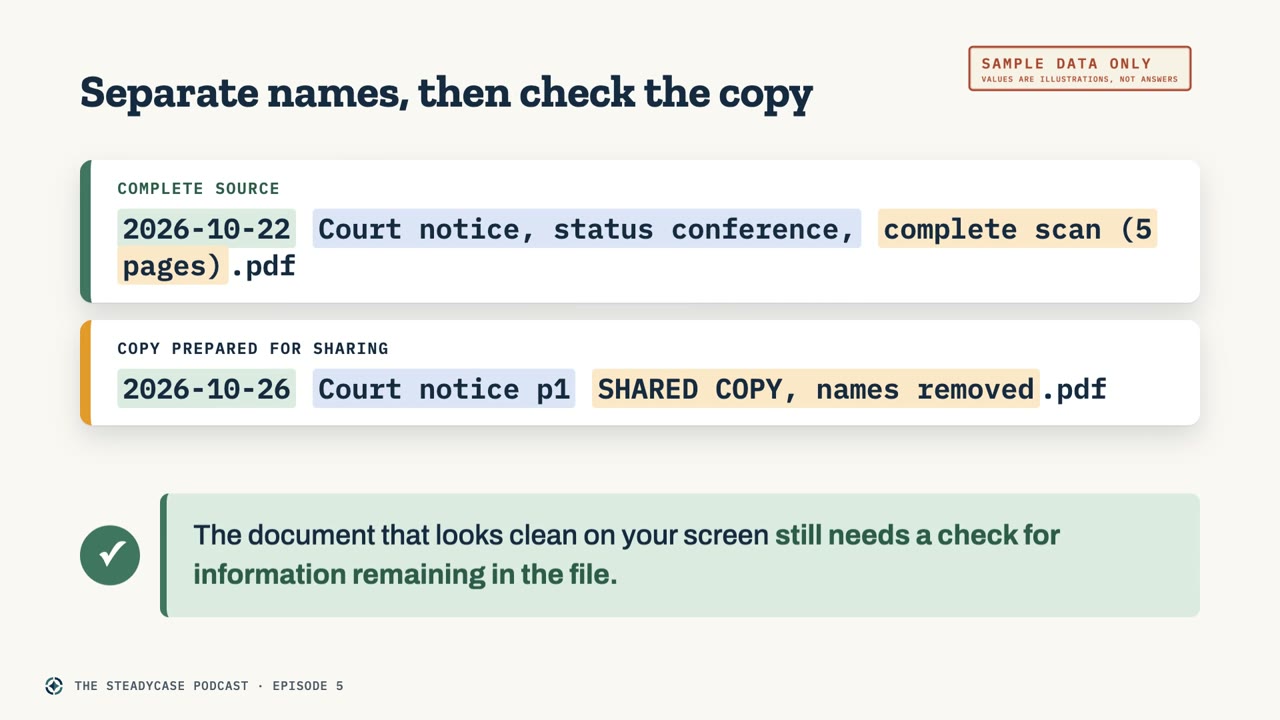
Keep the complete source separate from the copy prepared for sharing, and give the redacted copy a distinct file name. A document that looks clean on your screen still needs a check for information remaining in the file.
A made-up example: one court letter
Here is a hypothetical. A parent receives the court letter and saves a complete scan in the case archive. The question concerns one unfamiliar term, so the parent first considers whether a general explanation requires any upload at all.
That decision comes before preparing a copy. Removing a name does not automatically make an entire case document appropriate for an outside service.
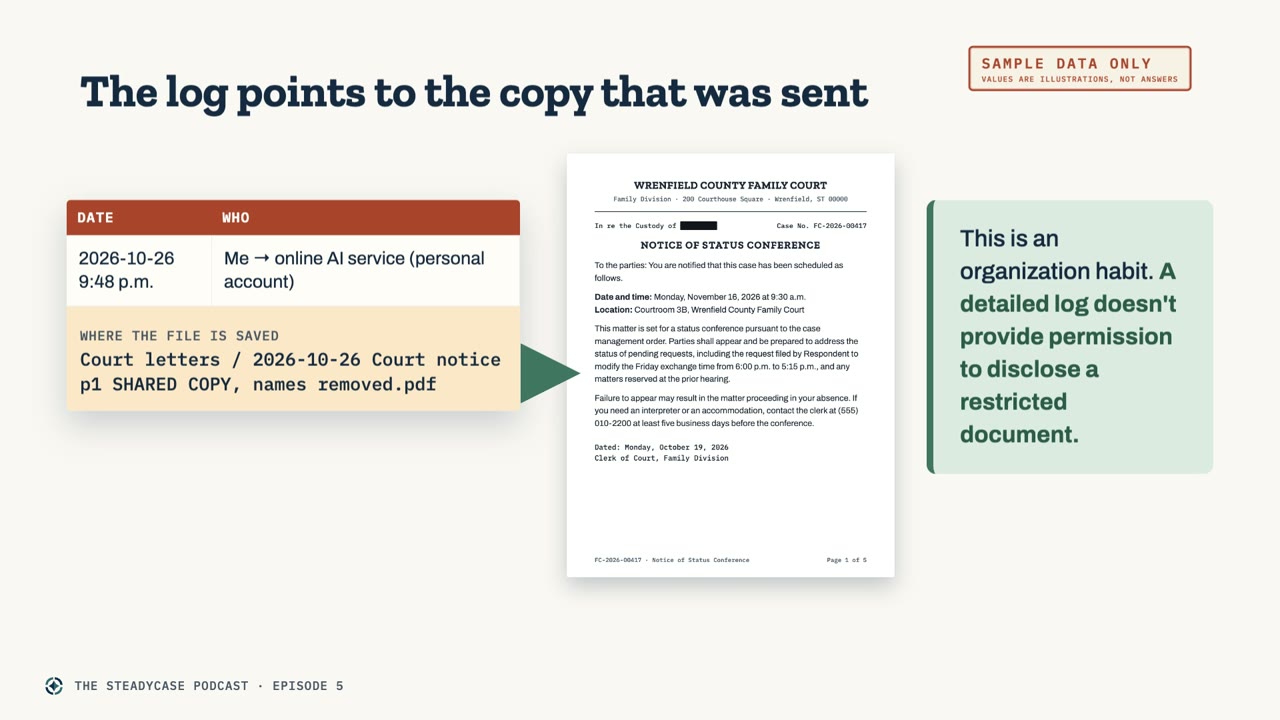
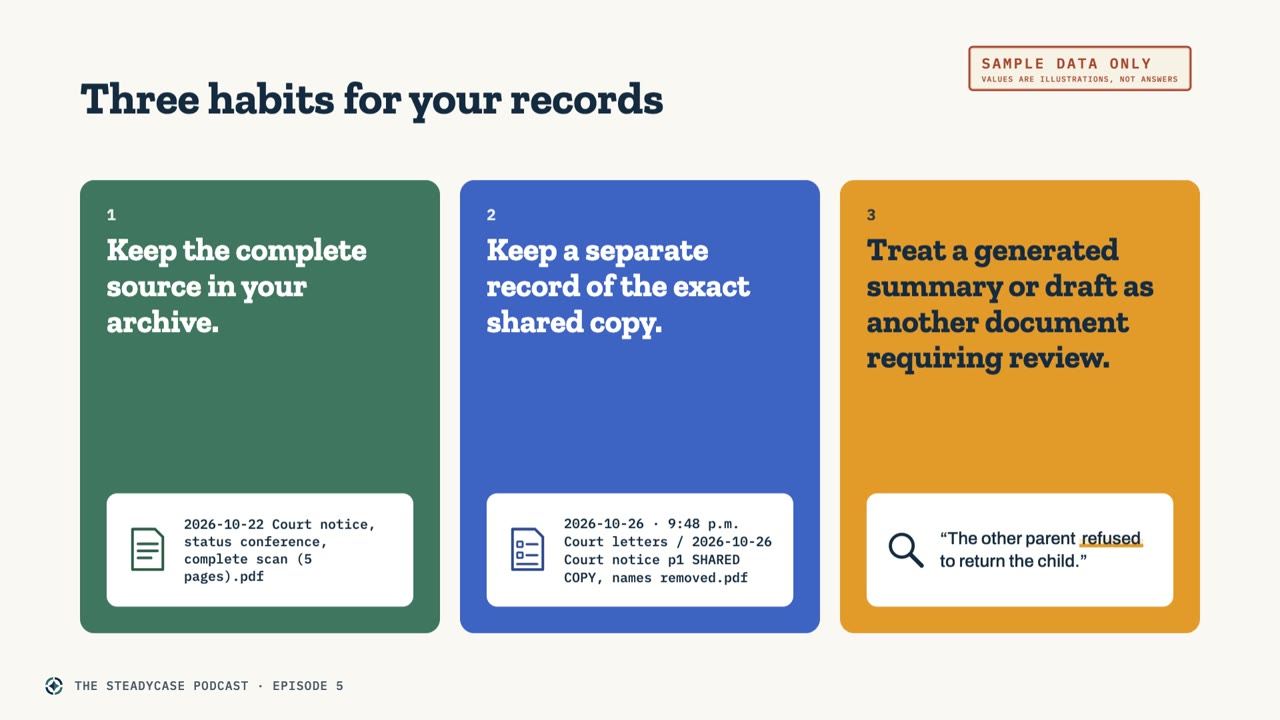
If the parent later shares a permitted copy, the archive should identify that exact version. A log entry records the date, the service, and the account type, and it points to the saved copy itself, the one shared with the service.
Suppose the upload contained only one page, with some information removed. A log pointing only to the complete five-page source would leave the parent guessing about the upload. Keeping both versions answers two different questions. What did the parent receive? What did the parent share?
This is an organization habit. A detailed log does not provide permission to disclose a restricted document.
An answer still needs checking
Now suppose the service has strong privacy protections. Its answer still needs review. An AI summary can leave information out or state something inaccurately. A generated citation can look convincing without identifying a real case. Those risks exist apart from the provider’s training policy.
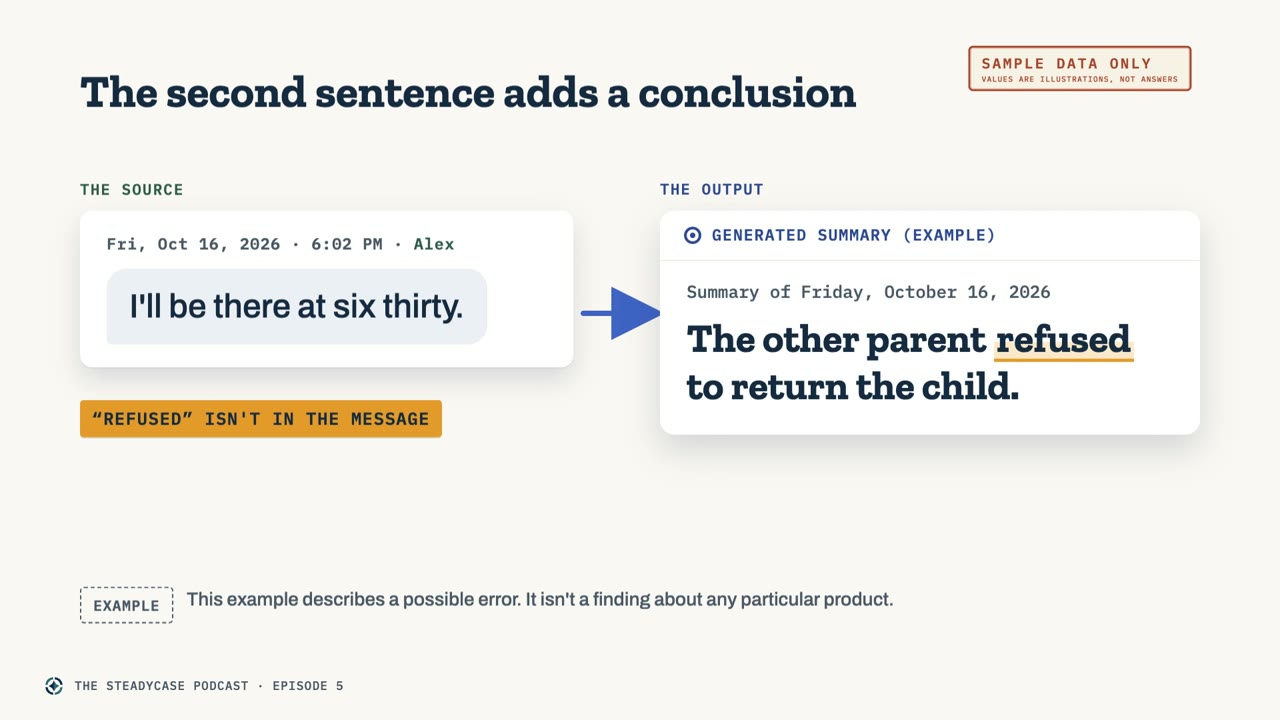
Here is another hypothetical. A text message says, “I’ll be there at six thirty.” The generated summary says, “The other parent refused to return the child.” The second sentence adds a conclusion. The quoted message alone does not establish a refusal.
So compare a summary with its source. Did it keep the date? Did it identify the right speaker? Did it turn an allegation into an established fact?
This example describes a possible error. It isn’t a finding about any particular product.
A real rule can still be the wrong rule
There is another step beyond checking whether a sentence is true. A real court rule may govern a different state. A real form may address a different kind of proceeding. A quotation may be accurate while the conclusion drawn from it goes beyond the decision.
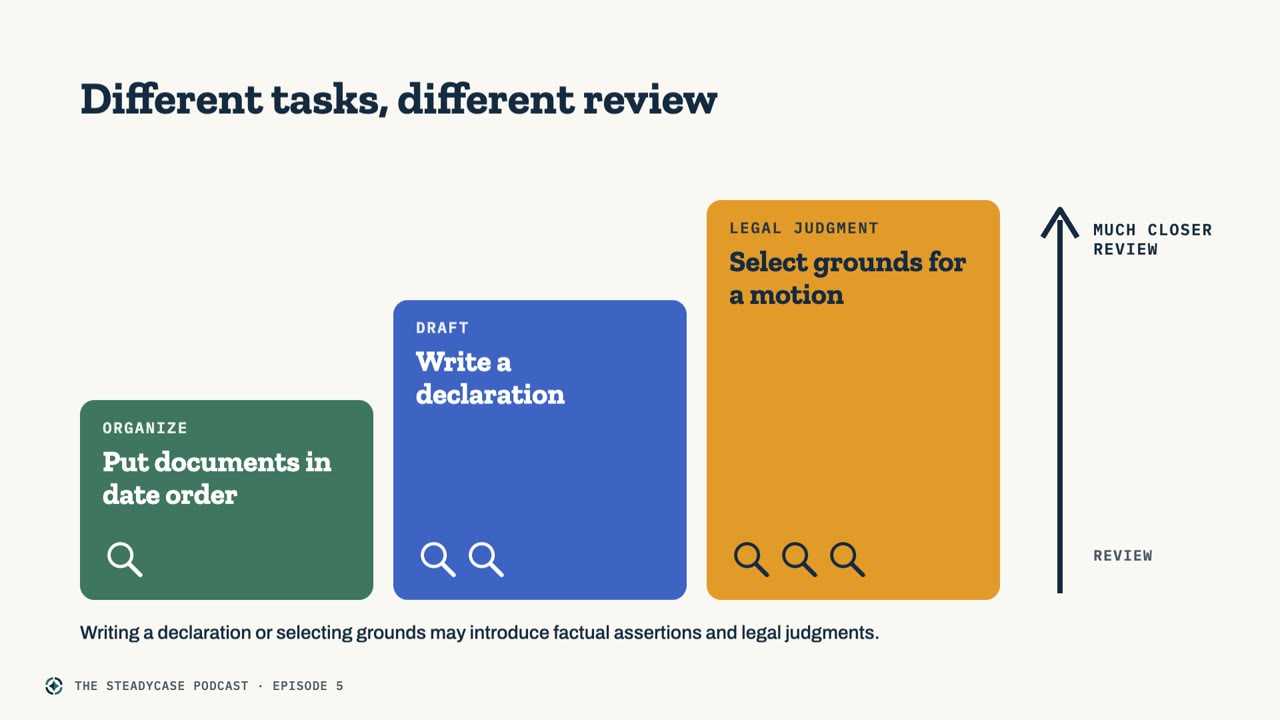
A tool that puts documents in date order does a different task from a tool that writes a declaration or selects grounds for a motion. The second kind may introduce factual assertions and legal judgments that require much closer review. A completed form can look finished while leaving those questions unanswered.
The distinction is useful even with an attorney. A generated draft can help identify questions for a conversation with that attorney. It does not establish that the proposed filing fits the case.
What courts have done about invented citations
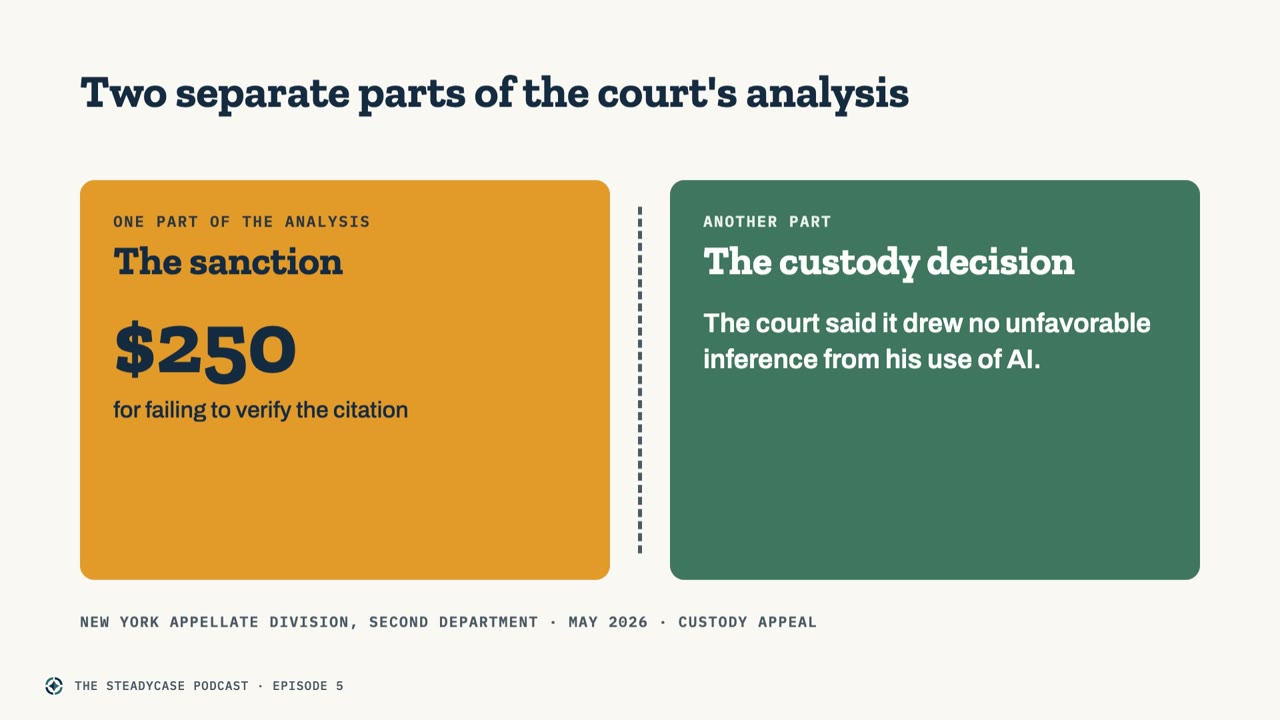
In May 2026, a New York appeals court considered a custody appeal by a self-represented father. His brief relied on an AI-generated citation to a nonexistent decision. The court imposed a $250 sanction for his failure to verify the authority.
When deciding the custody issues, the court expressly said it drew no unfavorable inference from his use of AI. The sanction and the custody decision were separate parts of its analysis.
Researcher Damien Charlotin maintains an international database of decisions involving hallucinated material. In the October snapshot we checked, it recorded more decisions involving self-represented litigants than decisions involving lawyers. That comparison is within a collection of reported decisions. It does not show which group makes more errors or gets caught more often. The database does not count every AI-assisted filing, and not every entry involves a monetary sanction.
In Florida, the state’s Supreme Court amended its rules in 2026. People signing court filings now represent that the cited legal authorities exist and are cited accurately. The requirement applies to attorneys and unrepresented parties. It is an accuracy requirement, not a ban on AI. Other courts have their own rules, so no single filing checklist covers everyone.
A chat, a saved file, and a connected copy
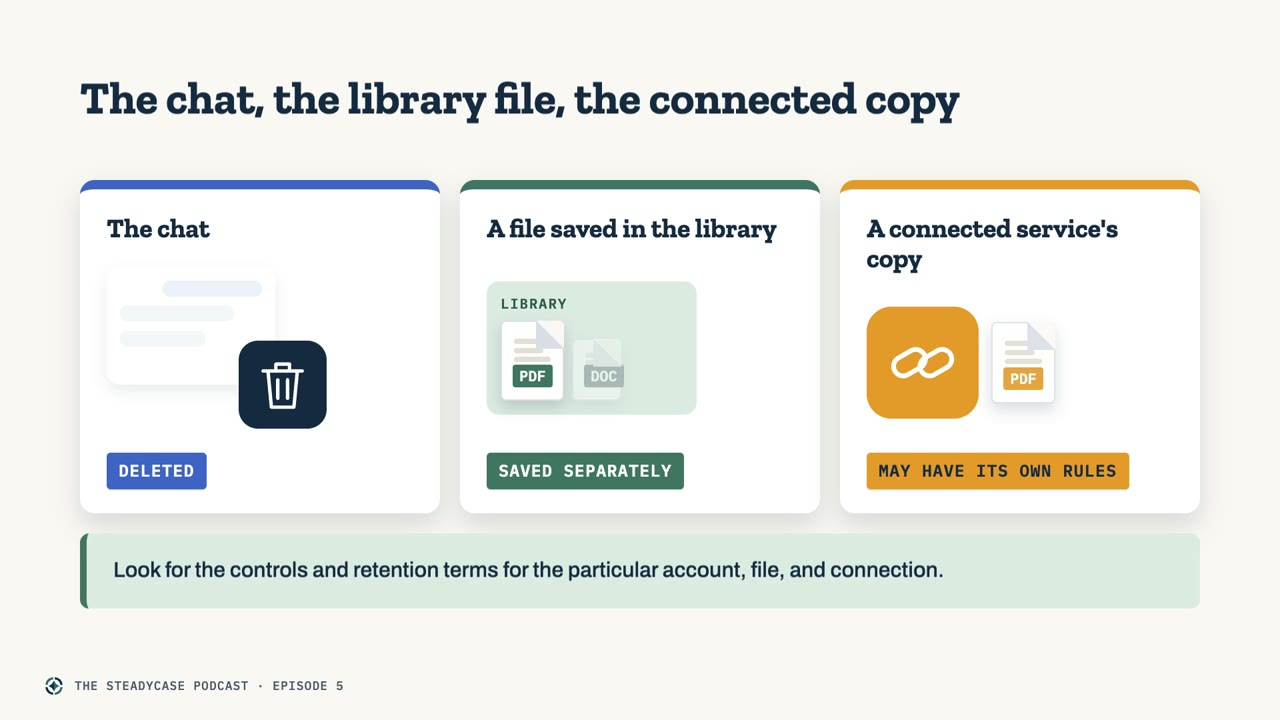
Deleting a chat may not delete everything. One provider says deleting a chat does not delete a file saved separately in its library. Another keeps some human-reviewed chats after activity deletion. Check the service’s current file and chat policies separately.
Think of the conversation and a file saved in a library as two things to manage separately. If a connected service also received information, its copy may have its own rules. Your own record of the exact shared copy identifies the material in question.
Three consumer policies, as of October 2026
The episode gives a snapshot of three companies’ published consumer policies as of October 2026. Policies change, so check the current page before relying on this summary.
On a personal ChatGPT plan, model improvement is on by default, and the user can disable that setting. Regular chats stay in the account until the user deletes them. OpenAI generally schedules deleted chats for removal within 30 days, with exceptions.
For Claude Free, Pro, and Max, Anthropic says using chats to improve Claude generally depends on the user’s choice, with stated safety and feedback exceptions. A deleted chat is generally removed from its back-end systems within 30 days. If the user allows model improvement, de-identified data may remain in its training pipeline for up to five years. Anthropic also says changing that setting cannot remove data from a training run already in progress.
For Gemini Apps, Google’s Keep Activity setting saves chats and allows activity to improve its services. The default auto-delete period is 18 months. Chats reviewed by humans can remain for up to three years, even after activity deletion. Turning Keep Activity off changes the handling of future chats, though Google says it keeps them for 72 hours to operate and protect the service.
Business accounts and connected services can have different terms. A provider’s privacy settings do not establish that a generated answer is correct.
Three habits for your records
Keep the complete source in your archive. Keep a separate record of the exact shared copy. Treat a generated summary or draft as another document requiring review.
The free Document Everything Method has the five-field log for that record: getsteadycase.com/document-everything.
Sources discussed in this episode
- Clio, 2025 Legal Trends Report
- JUSTICE and Administrative Fairness Lab, What AI Chatbots Can Teach Us About Unmet Legal Needs
- ABA Formal Opinion 512
- District of New Jersey, Personal Identity and Metadata Redaction Techniques for E-Filing
- Southern District of Alabama, Best Practices for Redaction of Information
- Matter of Julien v Arthur, 2026 NY Slip Op 03308
- Florida Supreme Court, SC2026-0673
- AI Hallucination Cases database, Damien Charlotin
- OpenAI, Data controls in ChatGPT
- OpenAI, Chat and file retention policies in ChatGPT
- OpenAI, How your data is used to improve model performance
- OpenAI, How OpenAI handles data in consumer services
- Anthropic, Is my data used for model training?
- Anthropic, How long do you store my data?
- Anthropic, Use connectors to extend Claude's capabilities
- Google, Gemini Apps Privacy Hub
Provider policies reflect October 2026. Policies change, so check the current page.
ChatGPT and OpenAI are trademarks of OpenAI. Claude and Anthropic are trademarks of Anthropic. Gemini and Google are trademarks of Google LLC. Steadycase is not affiliated with or endorsed by these companies.